
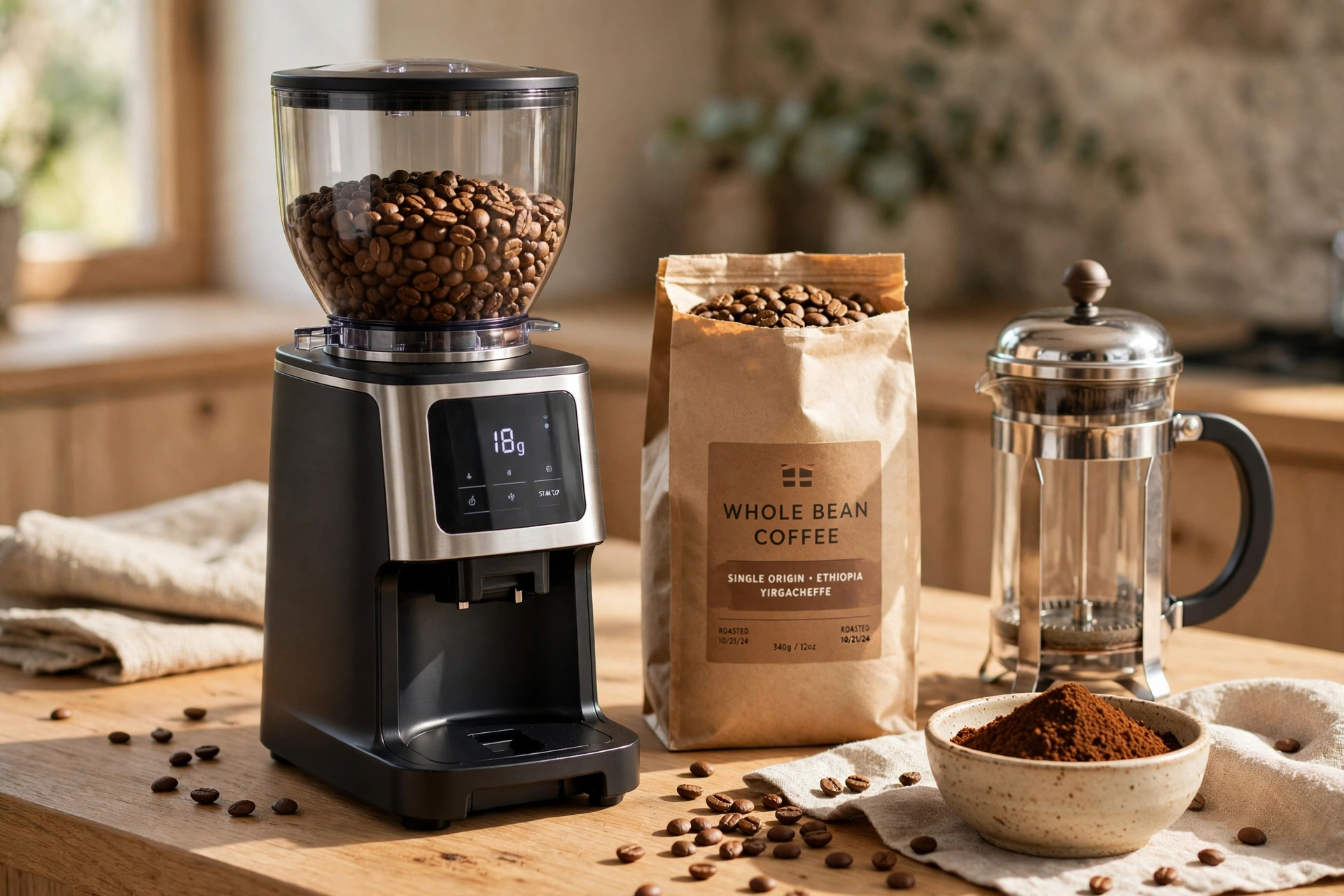
Best coffee grinders make the biggest difference to flavour in home brewing. Freshly grinding your beans just before brewing releases aromatics that pre-ground coffee loses within hours. A good grinder also gives a uniform particle size, so water extracts flavour evenly instead of over-extracting fine dust and under-extracting coarse chunks.
Contents: Why grind matters | Burr vs blade | 2026 picks at a glance | Best by brew method | How to choose | How to clean a coffee grinder | FAQs
Why the Best Coffee Grinders Matter
Your grinder often matters more than costly beans or expensive equipment. Even excellent beans taste flat or bitter when the grind is uneven. Consistent particles give even extraction, clearer sweetness and a cleaner finish in the cup.
Different brewing methods also need different grind sizes. Espresso needs a very fine, precise grind. Drip coffee needs a medium grind. French press needs a coarse grind, and cold brew needs an extra-coarse grind. A versatile grinder should cover your main method cleanly, not just grind beans into powder.
Burr vs Blade Grinder: Which Is Better?
A burr vs blade grinder comparison is simple: burr grinders crush beans between two burrs to a set size, while blade grinders chop beans with a spinning blade, like a small food processor. That chopping action creates a mix of fines and boulders, which causes uneven extraction.
| Type | Typical price | Verdict |
|---|---|---|
| Blade grinder | Typically $15 to $30 | Cheap but inconsistent. Best avoided unless your budget is extremely tight. |
| False-burr or disc grinder | Typically $40 to $80 | Better than blade, worse than a true burr grinder. A decent stepping stone. |
| True burr grinder | Typically $60 to $150 for entry models | Consistent, with multiple settings. The best value for most coffee drinkers. |
| Mid-range and premium burr grinder | Typically $150 to $400 and above | More precision, better build quality and often replaceable burrs. Essential for espresso and demanding brewing. |
Manual grinders are a special case. They offer total control, are portable and silent, and are good for travel and small kitchens. A good manual burr grinder can beat a cheap electric grinder for consistency, although hand-grinding takes more effort.
Best Coffee Grinders of 2026 at a Glance
| Grinder | Approx. price | Best for |
|---|---|---|
| Baratza Encore | Around $150 | Best all-round grinder |
| Baratza Encore ESP | Around $200 | Espresso and filter coffee |
| OXO Brew Conical Burr | Around $100 | Best budget coffee grinder |
| Fellow Opus | Around $200 | Espresso and filter, low retention |
| Baratza Virtuoso+ | Around $250 | Premium filter coffee |
| TIMEMORE Chestnut or 1Zpresso | Varies by model | Manual pick for travel and pour-over |
Baratza Encore: best all-round
The Baratza Encore is our best overall burr grinder. It offers a proven 40-setting conical burr, user-replaceable parts, a quiet DC motor and simple daily use. It gives exceptional reliability and support, consistent grinding across most methods and repairable construction.
Its main limits are a plastic feel and a lack of fine espresso optimisation. For most filter, drip and French press drinkers, however, it is a perfect entry point. You can check current specifications on the Baratza official site.
Baratza Encore ESP: best coffee grinder for espresso on a budget
The Baratza Encore ESP is the best budget espresso grinder in this guide. It offers 40 settings, a conical burr and a quiet DC motor, with user-replaceable burrs. Its strengths are reliable performance, good support and an affordable entry point into espresso grinding.
It offers less fine-tuning than premium espresso grinders, and it still has a plastic feel. For a first espresso grinder that also handles filter coffee, though, it is hard to beat at this price.
OXO Brew Conical Burr: best budget coffee grinder
The OXO Brew Conical Burr is the best budget coffee grinder for everyday filter coffee. It is simple to use, consistent enough for drip and French press, and much better value than any blade grinder. If you are upgrading from pre-ground coffee, this is a sensible first burr grinder.
Fellow Opus: low-retention all-rounder
The Fellow Opus suits drinkers who want espresso and filter coffee from one grinder. Its low-retention design means less old coffee stays inside the grinder between doses, so each cup tastes fresher. It is a stylish, versatile choice for a modern kitchen.
Baratza Virtuoso+: premium filter choice
The Baratza Virtuoso+ offers 40 settings, a digital timer, commercial-grade conical burrs, a DC motor and metal construction. It is versatile, gives repeatable dosing and reliable support, but it costs more and the timer adds complexity.
Choose it if you mainly brew filter coffee and want a step up in build quality and consistency from the Encore, without moving to a dedicated espresso grinder.
TIMEMORE Chestnut and 1Zpresso: best manual pick
For a manual pick, the TIMEMORE Chestnut range and 1Zpresso grinders are excellent. The TIMEMORE Chestnut C3 offers precision conical burrs, an ergonomic handle, a magnetic catch cup and all-metal internals. It is smooth and consistent, although cleaning needs partial disassembly.
The 1Zpresso Q Air is a lighter option, with 42 mm conical burrs, a lightweight 280 g aluminium body, a foldable handle and a 30-gram capacity. It gives excellent consistency and portability, but its small capacity limits batch brewing.
Best Coffee Grinder by Brew Method
Espresso
Espresso demands precision, stepless or micro-adjustments, single-dosing and low retention, so the grinder matters even more than for other methods. Manual grinders can work well for espresso, but electric models are more convenient for daily use.
For espresso, choose the Encore ESP or Fellow Opus from the picks above. Pair a good espresso grind with our Lavazza espresso guide or our De’Longhi coffee machine review, and use it for milk drinks in our latte guide.
Drip coffee
Drip coffee needs a consistent medium grind. Too fine, and the coffee tastes bitter. Too coarse, and it tastes weak and sour. The Encore, OXO Brew and Virtuoso+ all handle drip well. Follow our drip coffee guide once your grind is dialled in.
French press
The best coffee grinder for French press must grind coarse and evenly, with as few fines as possible. Fines slip through the mesh and make the cup muddy. A good burr grinder at a coarse setting, or a manual grinder such as the TIMEMORE Chestnut, works well here.
Cold brew
Cold brew needs an extra-coarse grind and a long steep, so consistency at the coarse end matters most. A burr grinder that stays even at coarse settings will give a smoother, sweeter result. See our cold brew guide for ratios and steep times.
How to Choose Among the Best Coffee Grinders
- Choose burrs over blades. Look for uniform particles with minimal fines and boulders.
- Prioritise consistency over speed and extras. A slower, even grind beats a fast, uneven one.
- Match the grinder to your main method. For espresso you need fine adjustment; broader steps are acceptable for French press.
- Choose a hopper size to match your use, and durable materials, with metal over plastic where possible.
- Check parts and support. Replaceable burrs and good support extend a grinder’s life for years.
Grinders under $50 are mostly blade grinders, with inconsistent grinding, poor build quality, plastic parts that can absorb oils and off-flavours, and inadequate grind settings. Prioritise a burr grinder over a blade grinder, and expect to upgrade within 6 to 12 months if you start at this level.
How to Clean a Coffee Grinder
Learning how to clean a coffee grinder keeps every cup tasting fresh. Old oils turn rancid and stale grounds spoil the next brew, even in the best burr coffee grinder.
- Unplug electric grinders and remove the hopper and any loose beans.
- Brush out loose grounds from the burrs and chute with a soft brush.
- Wipe the hopper and catch cup with a dry cloth. Avoid soaking electric parts.
- Deep-clean burrs every few months, following the maker’s instructions, and let parts dry fully before reassembly.
- Grind a small amount of fresh beans after cleaning to purge any residue.
Best Coffee Grinders: Frequently Asked Questions
Is a burr grinder really worth it? Yes. A burr grinder gives a far more uniform grind than a blade grinder, which means more even extraction and better flavour in every brew method.
What is the best coffee grinder for espresso? For most home users, the Baratza Encore ESP is the best value espresso choice. It offers fine adjustment, low retention for its price and reliable support.
How much should I spend? Around $100 buys a solid budget burr grinder, around $150 to $200 buys a strong all-rounder, and around $250 buys a premium filter grinder. Spend more only if you brew espresso daily or want single-dosing features.
Can one grinder do everything? The best all-round grinders cover filter, drip, French press and cold brew well. True espresso still needs finer, more precise adjustment, so an espresso-capable model such as the Encore ESP or Fellow Opus is the safest all-in-one choice.
Final Thoughts on the Best Coffee Grinders
Your grinder affects flavour more than your beans, your gear or your water temperature. Start with a good burr grinder that fits your main brewing method and your budget, then upgrade your beans and gear over time. For more tested picks, browse our Reviews category.
The best coffee grinders of 2026 are not the most expensive ones. They are the ones that grind evenly, suit your brew method and last for years. Choose the Encore for all-round value, the Encore ESP or Opus for espresso and filter, the OXO Brew for a tight budget, the Virtuoso+ for premium filter coffee, or a TIMEMORE or 1Zpresso for manual brewing, and your coffee will taste noticeably better.