
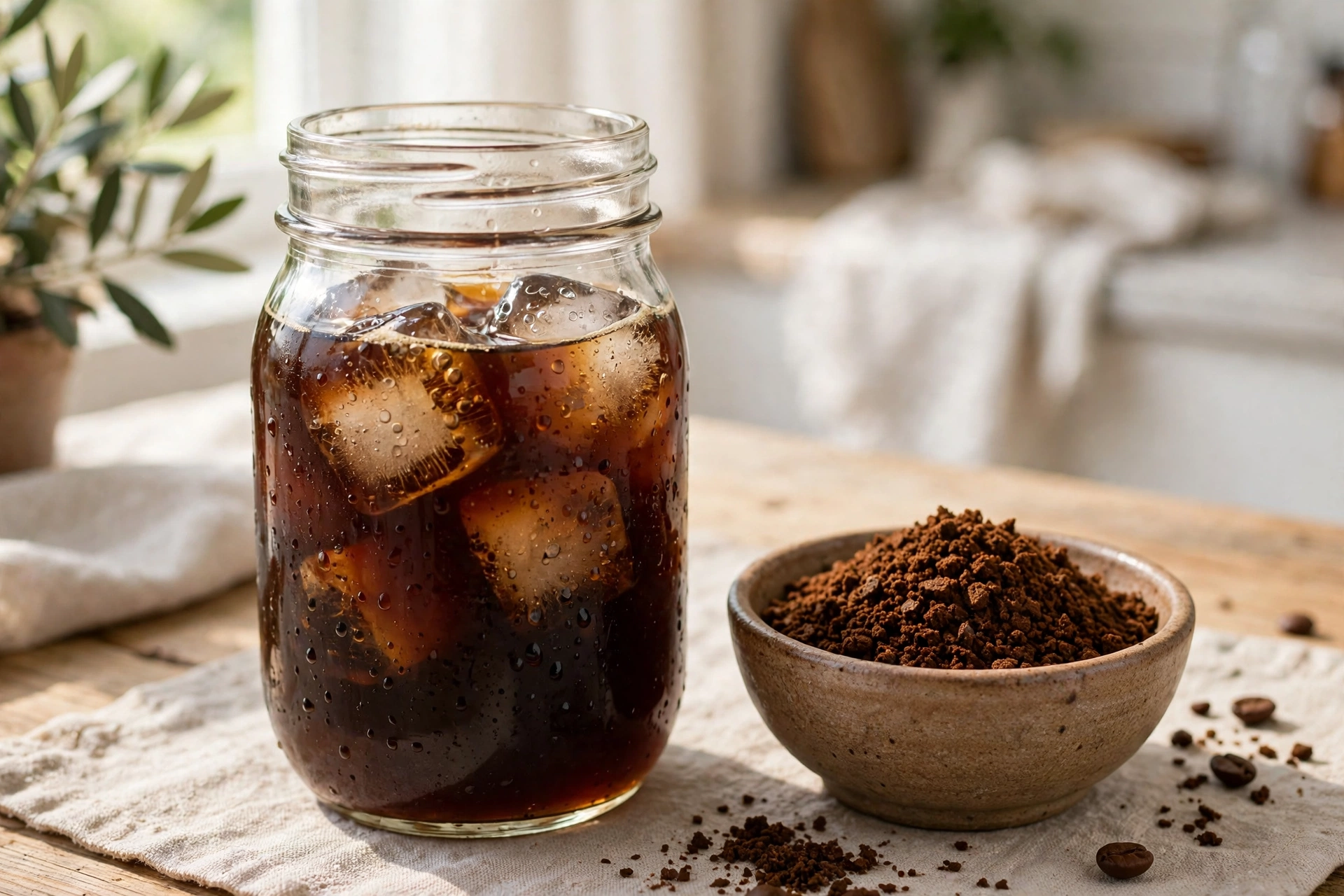
How to Make Cold Brew Coffee

This guide shows how to make cold brew coffee at home in a mason jar: coarse coffee, cold water and a long, gentle steep. No machine is needed.
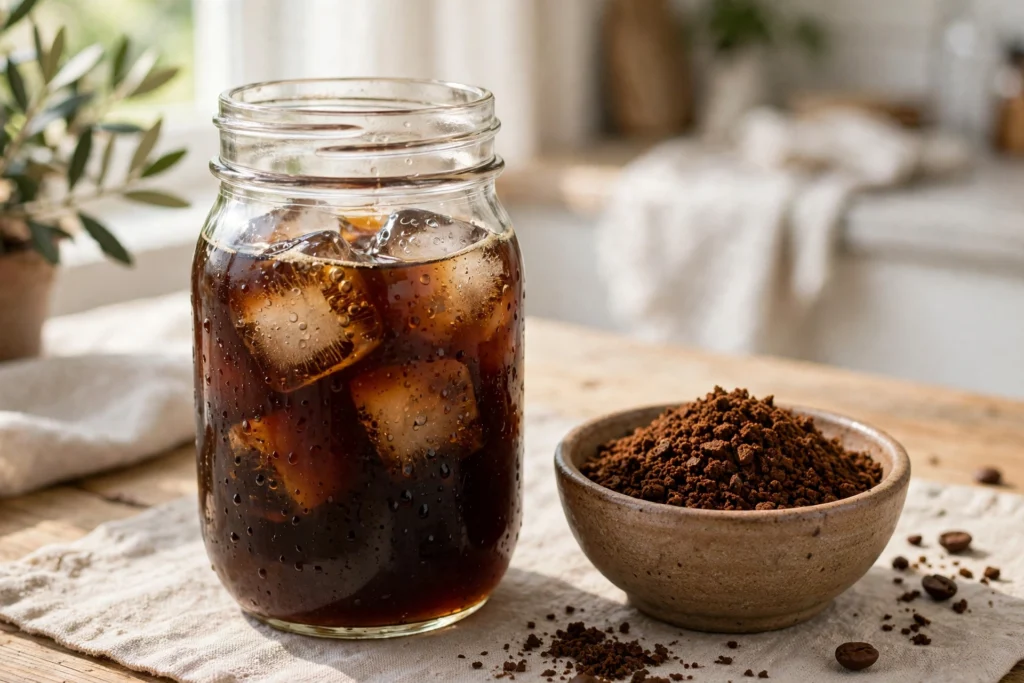
Cold water slowly extracts flavour from coarse grounds, giving a smooth drink that suits serving over ice.
You do not need special equipment. A jar, a grinder or pre-ground coarse coffee, and a strainer are enough to start.
How to Make Cold Brew Coffee at Home: Step-by-Step Cold Brew Coffee Recipe
Don’t know how to make cold brew coffee at home? And you want to have cafe-style cold brew coffee whenever you want? Let me guide you step by step to make this amazing recipe in a simple way.
Coarsely ground coffee: 100 g. Cold water: 800 ml (1:8 concentrate ratio). Cheesecloth or a fine strainer, for straining twice.
Put coffee beans in a large container and pour water over the coffee grounds. Minimum steeping time for a cold brew is at least 12 hours at room temperature, but it can be adjusted according to preference. Remember not to steep for less than 12 hours, as it won’t extract the flavour.
Commonly people find a balanced flavour between 16-20 hours. Although you can steep coffee beans for 24 hours, be careful of over-steeping. It can result in a bitter taste which is not recommended. It is better to always track steeping time carefully. For this recipe let’s consider 18 hours of steeping the coffee grounds.
This is an important and final step of the recipe. Place a few layers of cheesecloth on the top of the pitcher/jar you want to store the coffee in. Pour the coffee slowly through the cheesecloth to strain it and remove the remaining coffee grounds. For more precise and clear straining, use coffee filters after the cheesecloth, so you strain twice. Store the steeped coffee in the refrigerator to serve later.
Why Cold Brew Coffee Is Still a Favourite in 2026
To satisfy the craving for iced coffee in summer without a watery or overly bitter taste, cold brew coffee is the option for you. Cold brew can give you the exact flavour you want with a good amount of caffeine. It may feel like a time-consuming recipe, but you can brew at least 6 servings at a time. If you are learning how to make cold brew coffee at home, this method gives you a smooth, cafe-style result without a machine.
It can be more useful if you want to dilute it with water, as it makes it less acidic than a regular hot coffee. You can pour the concentrate directly over ice or heat it in the microwave. Moreover, you can make a hot coffee out of it within a few minutes. Boil 1/2 cup of water and let it sit for a few seconds. Pour the boiling water over 1/2 cup of coffee. Your hot coffee is ready. You can change the ratio of coffee to water to suit your taste to get different flavours.
Cold Brew vs Iced Coffee: What’s the Difference?
All types of coffee drinks have different flavour profiles. A lot of things distinguish them from each other. Here are some of the differences between cold brew and iced coffee.
The key difference between cold brew and iced coffee is the brewing method. Iced coffee is brewed by using a regular hot coffee brewing method. Afterwards, ice is added to make it a cold coffee. Cold brew, by contrast, is made by steeping coffee grounds in cold water.
Cold brew coffee needs at least 12 hours of steeping and the rest of the prep time is about 10 minutes. On the other hand, iced coffee can be ready in a few minutes only. Brew hot coffee, let it sit for a few minutes, add ice, and iced coffee is ready.
Cold coffee usually has a stronger flavour than regular coffee or iced coffee. Sometimes it is diluted with water to make it less strong. The iced coffee becomes watery as ice melts in it. A strongly brewed iced coffee can be saved from being watery.
Cold brew coffee contains more caffeine, as it is a concentrated brewing method, while iced coffee has less caffeine in it. That strength is worth remembering when you learn how to make cold brew coffee at home, so dilute the concentrate to taste.
Black cold brew made only from water and coffee contains no fat, protein or carbohydrate from those ingredients. Caffeine and energy per serving vary with bean, ratio and dilution, so no single figure is given here. Check the FDA caffeine guidance linked at the end of this guide if you are sensitive to caffeine.
Cold brew coffee is better than a regular iced coffee, as it is less acidic and watery. It is also a healthy drink because it lacks fat, protein and carbohydrates. It may take some time to prepare, but it brews a minimum of 6 servings (175 ml per serving) at a time, and you can store the concentrate in a refrigerator for up to 2 weeks, while diluted cold brew keeps for 3–5 days. In short, it is a lovely and delightful treat in the heat of summer for coffee lovers.
How do I make cold brew coffee at home? Use 100 g coarsely ground coffee and 800 ml cold water. Steep for about 18 hours at room temperature. Strain twice. Refrigerate the concentrate. Serve cold, or warm a diluted serving gently.
Can I make cold brew with regular coffee grounds? You can make cold brew with regular coffee grounds, but for better results it is recommended to use coarsely ground coffee beans.
How to make cold coffee at home? Use only two ingredients: 100 g coarsely ground coffee and 800 ml cold water. Steep for about 18 hours, then strain twice.
What’s the difference between cold brew and iced coffee? The key difference between cold brew and iced coffee is the brewing method. Iced coffee is brewed using regular hot coffee brewing methods, whereas cold brew is made by steeping coffee grounds in cold water for 18 hours.
Cold Brew Coffee Ratio: One Clear Guide
Use this single guide, not three competing ratios. Concentrate: 1 part coffee to 8 parts water (1:8). Dilute that concentrate with water, milk or ice to taste. Ready-to-drink, without dilution: 1 part coffee to 12 parts water (1:12). The recipe in this guide uses the 1:8 concentrate, so 100 g coffee to 800 ml water is a consistent example.
How Long to Steep Cold Brew, and Which Grind to Use?
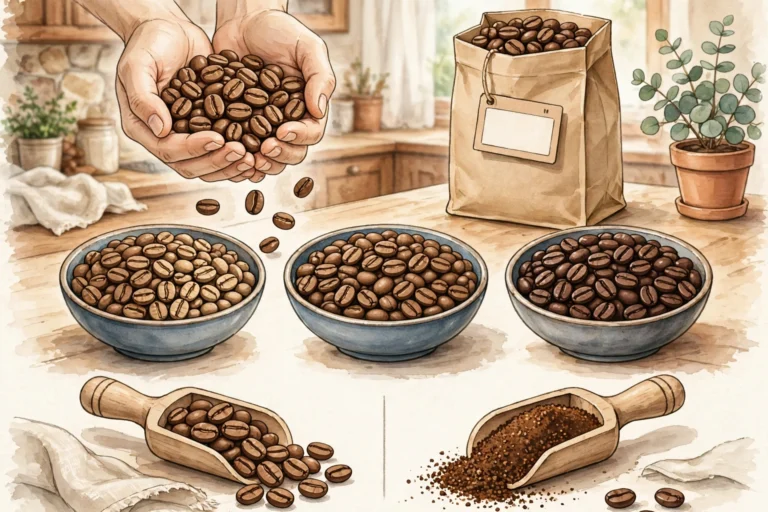
For how long to steep cold brew, use 12 hours for a lighter taste, 16–18 hours for a balanced taste, and avoid going over 24 hours, which can turn bitter. Use a coarse grind, about the size of raw sugar, so the coffee strains cleanly and does not become gritty. For the best coffee for cold brew, choose freshly roasted, medium- or dark-roast beans and grind them just before steeping. Getting this timing right is one of the most important parts of how to make cold brew coffee at home.
Fridge vs Room Temperature, and How to Strain Twice
Room-temperature steeping is faster and gives a fuller flavour, while fridge steeping is slower, smoother and easier to time. Either way, keep the container covered. To make cold brew in a mason jar, simply combine the grounds and water, seal it and steep it in the fridge or at room temperature. To strain twice, first pour through cheesecloth to remove the bulk of the grounds, then pour again through a paper coffee filter for a clear, smooth cold brew concentrate. Both options work well when you learn how to make cold brew coffee at home.
How to Store Cold Brew Concentrate
Store cold brew concentrate in a clean, sealed container in the refrigerator for up to 2 weeks. Once diluted, drink it within 3–5 days for the best flavour. If it smells sour or tastes off, discard it, even if it is within these times.
More FAQs About How to Make Cold Brew Coffee at Home
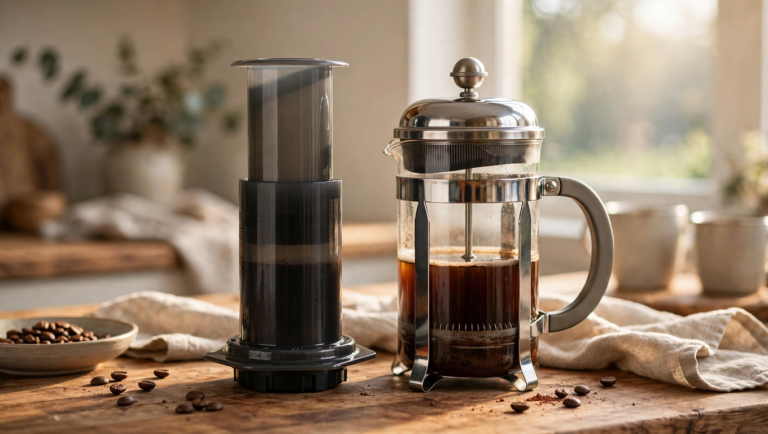
Can I use a mason jar? Yes, cold brew in a mason jar works well; just seal it, steep and strain twice. Can I use a French press? Yes, steep the grounds in the French press, then press slowly and strain again through a paper filter for a clearer brew. Why is my cold brew bitter or cloudy? Bitterness usually means it steeped too long or the grind was too fine, while cloudiness usually means fine grounds slipped through, so strain twice and use a coarse grind. How long does it keep? Cold brew concentrate keeps for up to 2 weeks refrigerated, and diluted cold brew keeps for 3–5 days. Now that you know how to make cold brew coffee at home, you can adjust the ratio and steep time to suit your taste.
Explore more brewing guides: latte, drip coffee, espresso, and the Brewing Guide category. For caffeine guidance, see the FDA advice on how much caffeine is too much.
For the coarse grind, see our best coffee grinders guide, and for an iced, flavoured version, try our peppermint mocha guide.
Cold brew is not the only slow, coarse-grind: try the same coarse grind in our French press coffee guide, and keep the beans you buy for it fresh with our guide to storing coffee beans.
What Trusted Sources Agree On — and Where They Differ
When you compare the trusted sources on cold brew, they agree on the fundamentals before they differ on the numbers. The National Coffee Association’s cold brew guide uses a coarse grind, room-temperature or cooler water, and a long steep, and it stresses that time is everything for cold brew. This guide follows the same fundamentals: coarse coffee, cold water, and a steep measured in hours, not minutes. Both also draw the same line between methods: cold brew and iced coffee are not interchangeable terms, because iced coffee is hot coffee cooled over ice while cold brew never uses hot water.
Where they differ is in the numbers, not the method. The National Coffee Association’s cold brew guide gives a ratio range of 1:4 to 1:5 coffee to water and a typical steep of about 12 hours, while noting that steep times vary from a few minutes to 12–18 hours and more. This guide fixes a single recipe instead: a 1:8 concentrate steeped 12 hours for a lighter taste and 16–18 hours for a balanced one, with 16–20 hours the range most people find balanced. Prima Coffee’s Learning Center and Stumptown’s Brew Guides organize their advice by method rather than prescribing one ratio.
The recommendation is to keep this guide’s recipe as the default and change one variable at a time. If a batch tastes weak, steep longer first, toward the 16–18 hour balanced window, before changing the ratio. If it tastes bitter, grind coarser or shorten the steep. Keep the coarse grind fixed in every test: every source agrees on it, and it is the one choice that protects the cup from grit and harshness at the same time.
Cold Brew Troubleshooting: Taste, Likely Cause, What to Change
Use this table when you learn how to make cold brew coffee at home and a batch tastes wrong. Start with fresh beans chosen well, keep the 1:8 ratio and the coarse grind fixed, and change only the one thing the table points to.
| Taste | Likely cause | What to change |
|---|---|---|
| Bitter or harsh | Steeped too long, or ground too fine | Shorten the steep toward 12 hours and grind coarser; change one at a time |
| Weak or watery | Too little coffee for the water, or too short a steep | Check the 1:8 ratio, then steep longer toward 16–18 hours |
| Sour or thin | Steep too short for the grind | Steep longer, and keep the grind coarse |
| Gritty or silty | Ground too fine, or strained only once | Grind coarser and strain twice, through cheesecloth and then a fine strainer |
A Note Worth Keeping
Two sentences are worth keeping beside this guide. “Cold brew vs iced coffee—both are great, but they’re not interchangeable terms, and here’s why!” — National Coffee Association, Cold brew coffee. And on choosing between methods: “Coffee is personal. The best brewing method is the one that results in your favorite coffee to drink!” — National Coffee Association, Brewing.
Cold Brew Questions Readers Also Ask
These three questions come up often when you learn how to make cold brew coffee at home, and none of them is answered in the guide above.
Can I heat cold brew concentrate? Yes. Pour the concentrate into a mug and add hot water to taste, instead of cold water or milk. Do not boil the concentrate itself: the long cold steep is what makes the cup smooth, so heat it by diluting with hot water instead.
Can I make cold brew with decaf coffee? Yes. The method does not change: use the same coarse grind, the same 1:8 ratio, and the same 12–18 hour window, and judge by taste. Remember that decaf does not mean caffeine-free, so a decaf cold brew still contains some caffeine.
Why does my cold brew taste bitter? Most often the steep ran too long for the grind, or the grind was too fine. Shorten the steep toward 12 hours, grind coarser, and strain twice — and change one thing at a time, so you know which change fixed it.
Closing Note: Judge Cold Brew by Its Last Glass
Judge a cold brew by its last glass, not its first. If the last glass from the jar tastes as smooth as the first, the ratio, the grind, and the steep are right. If it does not, change one variable and brew again — that is how you learn how to make cold brew coffee at home and get the same result twice.

13 Comments