Caffeine in Coffee, Tea and Energy Drinks Compared

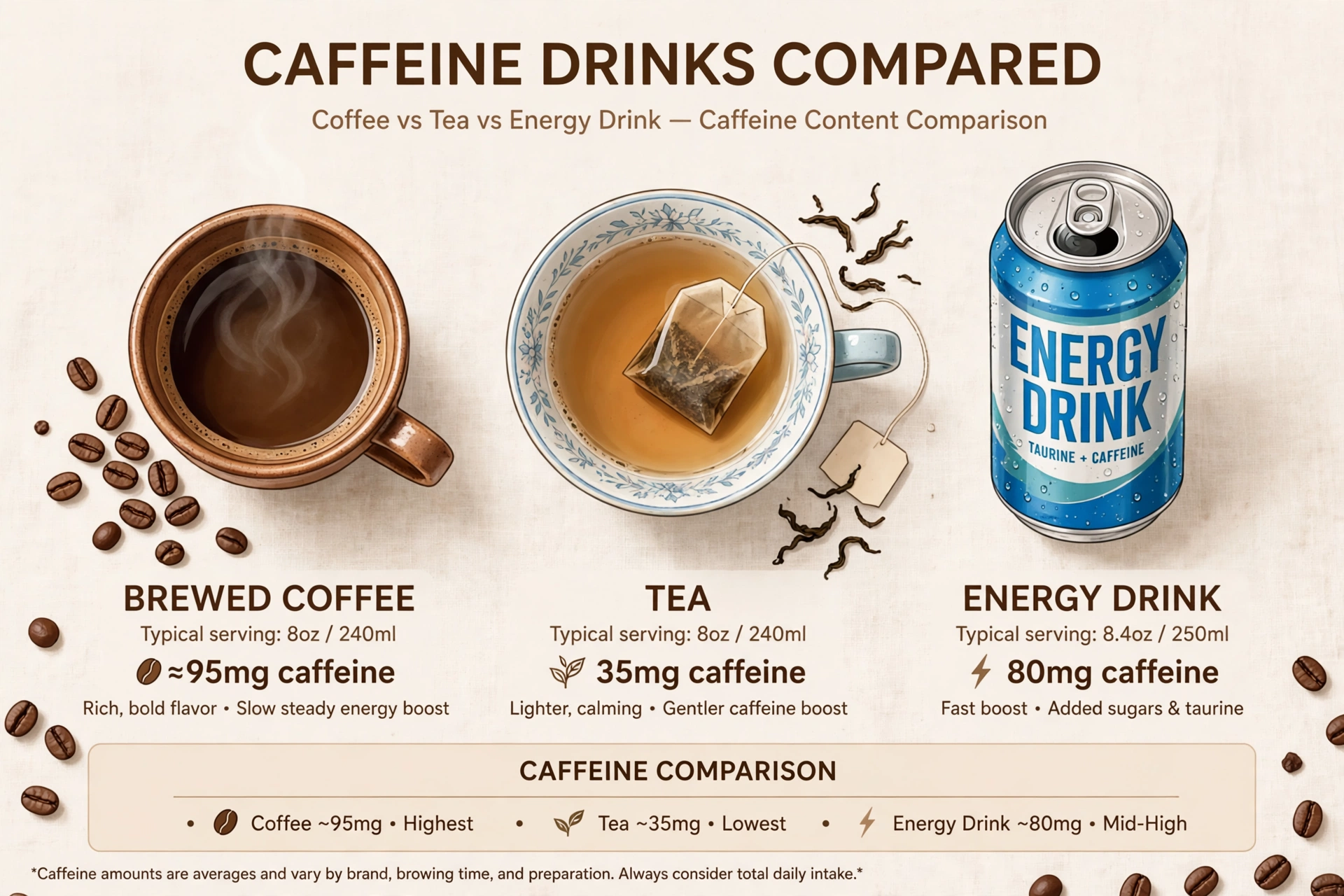
When you compare caffeine in coffee tea and energy drinks, there is no single winner: the answer depends on serving size. A typical 8-ounce cup of brewed coffee has about 96 mg of caffeine, a typical 8-ounce cup of black tea has about 48 mg, and a typical 8-ounce energy drink has about 79 mg….
When you compare caffeine in coffee tea and energy drinks, there is no single winner: the answer depends on serving size. A typical 8-ounce cup of brewed coffee has about 96 mg of caffeine, a typical 8-ounce cup of black tea has about 48 mg, and a typical 8-ounce energy drink has about 79 mg. Espresso looks stronger by the ounce, and an energy shot is far more concentrated, but neither is usually drunk in an 8-ounce serving. This guide puts the drinks on the same footing, so you can see what you are actually drinking.
All figures below are typical values from the Mayo Clinic table dated February 6, 2025, not exact amounts for every brand. Caffeine varies by product, brew method, bean or leaf, and serving size, so check the label on the drink in front of you when the exact amount matters.
Caffeine in Coffee Tea and Energy Drinks: The Like-for-Like Table
| Drink | Typical serving | Typical caffeine |
|---|---|---|
| Brewed coffee | 8 oz (237 ml) | 96 mg |
| Espresso | 1 oz (30 ml) | 63 mg |
| Instant coffee | 8 oz (237 ml) | 62 mg |
| Brewed black tea | 8 oz (237 ml) | 48 mg |
| Brewed green tea | 8 oz (237 ml) | 29 mg |
| Ready-to-drink black bottled tea | 8 oz (237 ml) | 26 mg |
| Energy drink | 8 oz (237 ml) | 79 mg |
| Energy shot | 2 oz (60 ml) | 200 mg |
| Brewed decaf coffee | 8 oz (237 ml) | 1 mg |
Source: Mayo Clinic, Caffeine content for coffee, tea, soda and more, February 6, 2025. The table is a guide to typical products, and the Mayo Clinic notes that caffeine content can vary by product and preparation.
That table is the fairest way to compare caffeine in coffee tea and energy drinks, because it stops the usual trick of comparing a small espresso with a large mug of tea, or a small energy shot with a full can. Once serving size is held steady, the ranking is clear: brewed coffee is highest per 8 ounces among the common hot drinks, energy drinks sit between coffee and black tea per 8 ounces, and green tea is lower again.
How Many Servings Reach About 400 mg?
Mayo Clinic states that up to 400 mg of caffeine a day may be safe for most adults, with qualifications for people who are pregnant, trying to become pregnant, or breastfeeding, who should talk with a health care provider. That 400 mg figure is a useful reference point for comparing servings, not a target to aim for and not personal advice.
Using the typical figures above, about 400 mg is roughly: four 8-ounce cups of brewed coffee (about 384 mg), about five 8-ounce energy drinks (about 395 mg), about eight 8-ounce cups of black tea (about 384 mg), about fourteen 8-ounce cups of green tea (about 406 mg), or two 2-ounce energy shots (400 mg). A latte made with a double shot of espresso would be about 126 mg from the espresso alone, before any other caffeine source, because each 1-ounce shot is typically about 63 mg. Milk does not remove caffeine, so a milky drink is not automatically a low-caffeine drink.
Those counts also show why a single how many drinks rule does not work. Two energy shots can reach the same typical total as four cups of brewed coffee, even though the shot looks much smaller. Likewise, a large takeaway coffee that is 16 ounces, not 8, can hold roughly double the caffeine of the table serving, depending on how it is made.
Coffee: Strongest Per Cup, But Not Per Ounce
Brewed coffee at 96 mg per 8 ounces is the strongest of the standard 8-ounce drinks in the table. Instant coffee is lower, at 62 mg per 8 ounces, which is closer to black tea than to brewed coffee. Espresso is the most concentrated drink here at 63 mg per ounce, but a single shot is only 1 ounce, so it delivers less caffeine in total than a full mug of brewed coffee. A double shot, two ounces, would be about 126 mg, which is still in the same range as one brewed cup, not double it.
Grind, dose, and brew time change the result. A longer, stronger brew with more coffee will have more caffeine than a light, short brew, even from the same beans. That is why home brewers who weigh their coffee, as in our French press guide, get more predictable cups than brewers who guess with a scoop.
Tea: Lower Per Cup, With a Wide Range
Black tea at 48 mg per 8 ounces has about half the caffeine of brewed coffee, and green tea at 29 mg is lower again. Ready-to-drink bottled black tea is lower still, at 26 mg per 8 ounces in the Mayo Clinic table. That does not make tea caffeine-free. A large mug of black tea, or several cups through the day, can add up to as much as a cup of coffee, and steeping longer or using more leaf will raise the amount.
For caffeine in coffee tea and energy drinks, tea is also where the word cup causes the most confusion. A small tea cup, a large mug, and a bottled tea are different servings, so compare the ounces, not just the number of cups.
Energy Drinks and Energy Shots: Watch the Serving, Not Just the Can
An 8-ounce energy drink at 79 mg sits below brewed coffee but above black tea. The trap is the can size: many energy drinks are sold in 16-ounce cans, which would be roughly double the 8-ounce figure if the product is uniform, and energy shots are a different product altogether. A 2-ounce energy shot at 200 mg is highly concentrated, so it should never be compared ounce-for-ounce with an 8-ounce drink, nor treated as just a small drink.
Energy drinks also vary more by brand than brewed coffee or plain tea, because makers use different formulas, sweeteners, and added ingredients. The label is the only reliable source for a specific can or shot. If a drink does not list caffeine, treat any comparison as an estimate, not a fact.
Common Mistakes When Comparing Caffeine
Comparing different sizes
An espresso shot, a mug of tea, and a large energy drink are not like-for-like. Always check ounces or milliliters first.
Assuming decaf means zero
Brewed decaf coffee in the Mayo Clinic table is shown at about 1 mg per 8 ounces, which is very low but not literally zero for every product. Decaf tea and decaf coffee still need a label check if the exact amount matters.
Assuming tea is always gentle and coffee is always strong
Strong black tea, a large mug, or several cups can outrank a small, weak coffee. The drink name alone does not settle it.
Forgetting the rest of the day
Caffeine adds up across coffee, tea, energy drinks, cola, and chocolate. A single-drink comparison is useful, but a daily total is what matters for the 400 mg reference point.
Frequently Asked Questions
Which has the most caffeine: coffee, tea, or energy drinks?
Per 8 ounces, brewed coffee is highest in the Mayo Clinic table at 96 mg, followed by energy drinks at 79 mg, black tea at 48 mg, and green tea at 29 mg. Per ounce, espresso is most concentrated, and per small serving, an energy shot is highest at 200 mg per 2 ounces. The fair answer depends on the serving you choose.
Is one energy drink the same as one coffee?
Not necessarily. A typical 8-ounce energy drink has about 79 mg, compared with 96 mg for 8 ounces of brewed coffee, but a larger can will have more, and an energy shot has much more in a smaller volume. Check the can size and the label.
How can I cut back without stopping suddenly?
Many people find it easier to change one drink at a time, for example swapping one brewed coffee for black tea, or a large serving for a smaller one, rather than changing everything at once. If you notice headaches, sleep problems, or other symptoms when cutting back, or you have a health condition, talk with a health care provider rather than relying on a general guide.
Conclusion and Next Steps
For a fair comparison, caffeine in coffee tea and energy drinks should always be compared by serving size: brewed coffee leads per 8-ounce cup, energy drinks sit in the middle, tea is lower per cup, espresso is strongest per ounce, and energy shots are the most concentrated small serving. Use the Mayo Clinic table as a starting guide, check labels for specific brands, and count ounces as well as cups.
For more on the signs of dependence, see our guide on caffeine addiction. For the wider picture on coffee and health, read the health benefits article, and for a milky espresso drink, see how to make a latte at home. For the source table used here, see the Mayo Clinic caffeine content page.
By Rizwan, Coffee Treasures.
Further Reading
- Am I Addicted to Caffeine? A Caffeine Addiction Guide
- Health Benefits of Coffee: What the Evidence Actually Shows
- How to Make a Latte Coffee
- How to Make French Press Coffee at Home
- Mayo Clinic: Caffeine content for coffee, tea, soda and more
Quick Comparison to Remember
If you remember only one rule, remember this: caffeine in coffee tea and energy drinks is only comparable when the serving size is the same. Brewed coffee is highest per 8 ounces, energy drinks are next, black tea is about half of coffee, and green tea is lower again. Keep that serving-size rule in mind whenever you compare caffeine in coffee tea and energy drinks on a label, and check whether the can, mug, or shot in your hand matches the serving in the table.
That is why a single number, without a serving, tells you little about caffeine in coffee tea and energy drinks, and why the table above is the better starting point. Use it to compare caffeine in coffee tea and energy drinks before you buy a larger can or a second shot.