Decaf Coffee Guide: 7 Facts That Make Switching Easier

Short answer: This decaf coffee guide starts with the key fact: decaf is real coffee with about 97% of its caffeine removed, not caffeine-free coffee. A typical 8-ounce cup of decaf has 2 to 15 mg of caffeine, compared with 95 mg in a typical 8-ounce cup of caffeinated coffee, according to the National Coffee…
Short answer: This decaf coffee guide starts with the key fact: decaf is real coffee with about 97% of its caffeine removed, not caffeine-free coffee. A typical 8-ounce cup of decaf has 2 to 15 mg of caffeine, compared with 95 mg in a typical 8-ounce cup of caffeinated coffee, according to the National Coffee Association (NCA). It keeps much of coffee’s flavour and many of its natural compounds, so it suits people who want the taste and ritual of coffee with far less caffeine.

Decaf is often misunderstood. It is not a different plant or a chemical imitation. Decaf starts as ordinary coffee beans, the caffeine is removed from the green beans before roasting, and the beans are then roasted and brewed in the usual ways.
Decaf vs Regular Coffee at a Glance
| Item | Regular coffee | Decaf coffee |
|---|---|---|
| Caffeine in a typical 8-ounce cup | 95 mg | 2 to 15 mg |
| Caffeine removed | Not applicable | About 97% |
| Starting point | Coffee beans | The same coffee beans, decaffeinated before roasting |
| Flavour | Full coffee flavour | Often similar, depending on bean, roast, and freshness |
| Brewing | Any method | Any method, with the same grind for that method |
Those caffeine figures are the NCA’s typical values for an 8-ounce cup. Actual caffeine varies with bean, roast, and brew method, so treat 2 to 15 mg as a range, not a promise for every cup. The important point is the scale: decaf is a large reduction, not a total removal.
How Decaffeination Works: The European Method in 5 Steps
The NCA describes the European Method as the most common decaffeination method. It works on green, unroasted beans, in five steps:
- Steam the beans. Steaming opens the pores of the beans, so caffeine can be removed.
- Rinse with a liquid solvent. The beans are rinsed with a liquid solvent that bonds to and removes caffeine.
- Remove the solution. The solution containing the extracted caffeine is removed from the beans.
- Recover the solvent. Caffeine is extracted from the rinsing solution for use in other products, and the NCA notes that nearly 100% of the rinsing agent is recovered.
- Dry and roast as usual. The decaffeinated beans are dried and roasted like caffeinated beans.
Other decaffeination methods exist, and a bag’s label is the place to check which method was used for that coffee. This guide details the European Method because it is the method the NCA describes in full. For this method, the NCA reports that the U.S. Food and Drug Administration (FDA) has rigorous standards and has said the risk to consumers is “essentially non-existent.” That statement is reported here as the NCA reports it, for this method, not as a general guarantee for all products.
Does Decaf Still Contain Caffeine?
Yes, a small amount. At 2 to 15 mg per 8-ounce cup, one decaf is far below a regular cup, but several decafs still add up. Someone who drinks many decafs in a day, or who also drinks tea, chocolate, or energy drinks, should count those sources too. For context, Mayo Clinic states that up to 400 mg of caffeine a day seems safe for most adults, which it describes as about the amount in four cups of brewed coffee. Decaf sits well below that per cup, but the 400 mg figure is a general guide for most adults, not a personal limit.
Mayo Clinic also lists symptoms of heavy caffeine use, including headache, insomnia, nervousness, frequent urination, fast heartbeat, muscle tremors, and stomach upset, and notes that cutting back suddenly can cause withdrawal symptoms such as headaches, tiredness, and cravings. Its advice is to cut back gradually, and it lists “try decaf” among its cut-back tips. If you have a health condition, take medication, or have been advised to limit caffeine, check with a healthcare provider; the NCA makes the same point that individual conditions vary.
Does Decaf Taste Different From Regular Coffee?
Often, less than people expect. The NCA notes that decaf coffee contains many of the same natural compounds found in caffeinated coffee, just with most of the caffeine removed. That is why a good decaf can taste like coffee first and “decaf” second. Where decaf disappoints, the cause is usually the same as with regular coffee: stale beans, a roast that does not suit the bean, or a grind and brew method that do not match. Freshness matters more than the decaf label.
To get the best from decaf, buy fresh beans, check the roast date where it is given, and store them properly; see how to choose fresh coffee beans and how to store coffee beans to keep them fresh. Then brew decaf exactly as you would the same bean with caffeine: drip, French press, moka pot, or espresso, with the grind for that method. See how to brew drip coffee at home, how to make French press coffee at home, how to make moka pot coffee at home, and how to make espresso at home., or, for a longer diluted drink, see our how to make americano at home
Who Does Decaf Suit?
Decaf suits anyone who wants coffee flavour with far less caffeine, especially in the evening, or when cutting back. It also suits people who love the ritual of a morning cup but do not want a second or third full-caffeine cup later in the day. It does not suit someone who needs coffee to be completely caffeine-free, because it is not.
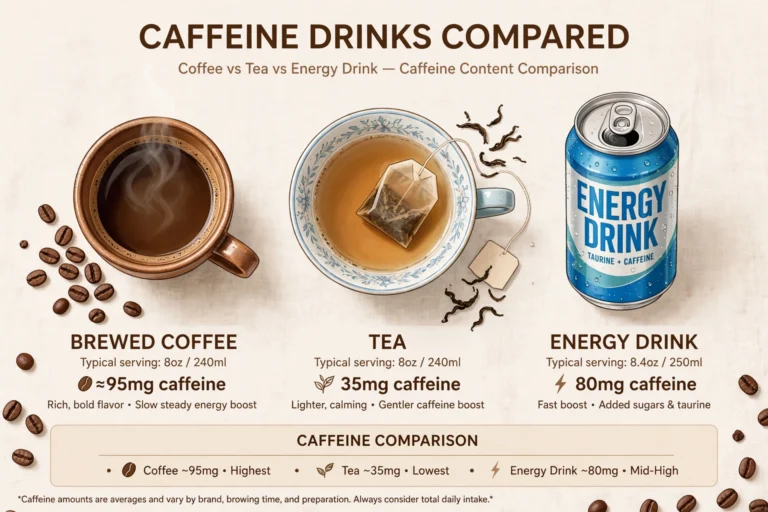
For the wider picture, see our comparison of caffeine in coffee, tea, and energy drinks, our guide to the health benefits of coffee, and am I addicted to caffeine? if cutting back feels difficult.
Choosing Decaf: What to Check Before You Buy
| Problem | Likely cause | Try this first |
|---|---|---|
| Flat or dull taste | Stale beans, or a roast that does not suit you | Buy fresher beans, try a different roast, grind fresh |
| Weak cup | Too little coffee, or grind too coarse for the method | Check the dose, match the grind to the brewer |
| Bitter cup | Over-extraction, or water too hot for the method | Grind a little coarser, check brew time and temperature |
| Still feeling wired | Other caffeine sources, or many decafs in one day | Count all caffeine sources, and check with a provider if concerned |
What the Sources Agree On
The NCA and Mayo Clinic agree on the points that matter most. The NCA gives the decaf-specific numbers: about 97% of caffeine removed, and 2 to 15 mg left in a typical 8-ounce cup, against 95 mg in regular coffee. Mayo Clinic gives the daily context: up to 400 mg a day seems safe for most adults, heavy use brings symptoms, and cutting back should be gradual, with decaf as one practical step. Neither source presents decaf as caffeine-free, and both point to individual variation.
Frequently Asked Questions
Is decaf coffee completely caffeine-free?
No. Decaffeination removes about 97% of the caffeine naturally found in coffee, leaving a typical 8-ounce cup with 2 to 15 mg, according to the NCA. If you need zero caffeine, decaf does not meet that standard.
Does decaf taste the same as regular coffee?
It can taste very similar, because decaf contains many of the same natural compounds as regular coffee, with most caffeine removed. Bean quality, roast, freshness, and brew method usually make a bigger difference to taste than the decaf process itself.
Is decaf safe to drink every day?
Decaf is ordinary coffee with most caffeine removed, and the NCA reports that the FDA has described the risk from the European Method as “essentially non-existent.” That is not a personal medical clearance: individual conditions vary, so check with a healthcare provider if you have a condition or have been advised to limit caffeine.
A Final Note
This decaf coffee guide ends where it began: decaf is coffee, with about 97% of the caffeine removed and a small amount left. Buy it fresh, brew it well, count it honestly alongside your other caffeine, and let taste, not the label, decide whether it earns a place in your day.
Sources
- National Coffee Association — Decaf Coffee (about 97% removed; 8-ounce cup: regular 95 mg, decaf 2 to 15 mg; European Method steps; FDA “essentially non-existent” risk phrase)
- Mayo Clinic — Caffeine: How Much Is Too Much? (up to 400 mg a day seems safe for most adults; cut back gradually; “try decaf” as a cut-back tip)