

Cortado vs Flat White: What’s the Real Difference?

If you have ever hesitated at a café counter between two small, strong, milk-based coffees, the question of cortado vs flat white is probably the reason. Both start with espresso, and both use far less milk than a latte. Yet they are not the same drink, and the difference is not just the name on the menu.
The real difference is proportion. A cortado uses equal parts espresso and milk. A flat white uses roughly twice to three times as much milk as espresso. That single change affects cup size, strength, creaminess, and calories. This guide compares the two drinks in 2026, with the latte and cappuccino included for comparison.

Cortado vs Flat White: The Quick Answer
In short, a cortado is the stronger-tasting of the two. It is smaller, it has less milk, and the espresso flavor stays front and center. A flat white is smoother and creamier. It is a little larger, it has more milk, and the espresso flavor is still clear but softer around the edges.
Neither drink is automatically better. If you like coffee that tastes like coffee, with milk as a supporting player, choose the cortado. If you like a silky, balanced drink, with milk and espresso working together, choose the flat white.
| Drink | Espresso to milk ratio | Typical size | Milk | Foam |
|---|---|---|---|---|
| Cortado | 1:1 | About 4–4.5 oz (120–130 ml) | Warm milk, equal to the espresso | Little to no foam |
| Flat white | About 1:2 to 1:3 | About 5–6 oz (150–180 ml) | Steamed milk with microfoam | Thin layer of microfoam |
| Latte | Roughly 1:3–1:4 | About 8–12 oz | Much more steamed milk | Light foam layer, often with latte art |
| Cappuccino | 1:1:1 espresso, steamed milk, foam | About 5–6 oz | Steamed milk plus a thick foam cap | Thick, airy foam |
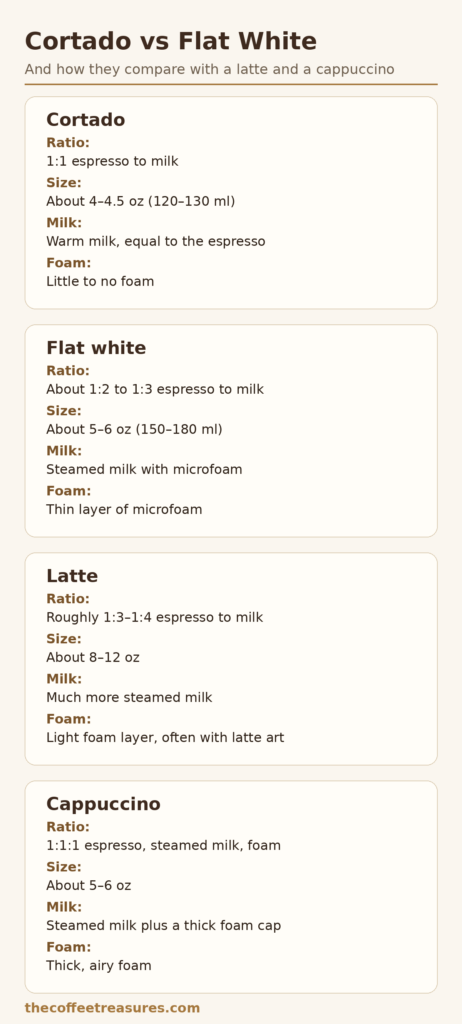
A flat white and a cappuccino can be a similar size, but their texture is very different. A latte is in a different size category altogether. When both drinks are made with the same double shot of espresso, they also contain the same amount of caffeine. The cortado tastes stronger because less milk dilutes the espresso, not because it has more caffeine.
What Is a Cortado?
A cortado comes from Spain, specifically from the Basque Country. Its name comes from the Spanish word “cortar,” which means “to cut.” The idea is right there in the name: the milk cuts the espresso, taking the sharp edge off the coffee without turning the drink milky.
A cortado is made with equal parts espresso and steamed milk, a ratio of 1:1. A cortado is usually a double shot cut with an equal volume of milk, so the two parts balance each other exactly. The result is a small, direct drink in which the espresso flavor is still the main event, softened just enough by the milk to make it smooth and easy to drink.
A cortado is served at about 4–4.5 oz (120–130 ml), often in a small Gibraltar glass. There is little to no foam. The milk is warm and smooth, not frothed into a thick cap, so the surface stays flat and clean. In Spain, a cortado is traditionally an afternoon drink: a short pause in the day, not a big morning cup.
For a fuller look at the espresso that forms its base, see how to make espresso at home. Cortado coffee works best when the espresso itself is well made, because there is so little milk to hide behind.
What Is a Flat White?
A flat white originated in Australia or New Zealand in the 1980s. Both countries claim it, and the debate is unresolved. What is not in dispute is the style of the drink: a double shot of espresso with steamed milk and a thin layer of microfoam.
A flat white is served at about 5–6 oz (150–180 ml). Its ratio is about 1:2 to 1:3 espresso to milk, roughly twice to three times as much milk as espresso. That extra milk is the main reason a flat white tastes smoother and feels creamier than a cortado, even when both drinks start with the same double shot.
Its defining feature is texture. The milk is steamed into velvety microfoam, made of tiny, fine bubbles rather than the large, airy bubbles on a cappuccino. The foam layer is thin, and the milk and foam blend into one smooth, glossy texture. When poured well, a flat white can carry latte art. A flat white is sometimes made with two ristretto shots, a shorter, more concentrated pull of espresso.
To compare it with the milkiest drink on the menu, see how to make a latte at home.
Cortado vs Flat White Ratio, Size, and Strength
The ratio is the heart of the cortado vs flat white comparison. A cortado is 1:1, equal parts espresso and milk. A flat white is about 1:2 to 1:3, one part espresso to two or three parts milk. In other words, a flat white can have two or three times as much milk per shot of espresso as a cortado.
Size follows ratio. A cortado is about 4–4.5 oz (120–130 ml). A flat white is about 5–6 oz (150–180 ml). The flat white is not a large drink, but it is noticeably larger, and that extra volume is almost entirely milk.
Strength is where most people get confused. If both drinks are made with the same double shot of espresso, they have the same caffeine. The cortado does not give you more caffeine, and the flat white does not give you less. The difference is taste, not caffeine. A cortado tastes stronger because less milk dilutes the espresso. A flat white tastes smoother because more milk dilutes it, softening and rounding the coffee flavor.
That is why the cortado vs flat white ratio matters more than the name on the cup. A 1:1 drink will always taste stronger than a 1:3 drink made from the same espresso. For comparison, a latte is about 8–12 oz, with roughly 1:3–1:4 espresso to milk, while a cappuccino is equal parts espresso, steamed milk, and foam (1:1:1) in a cup of about 5–6 oz. See how to make cappuccino at home for that foam-forward style.
Milk and Texture Differences
A cortado uses warm milk with little to no foam. The milk is heated and blended with the espresso, but it is not built up into a frothy layer. The surface stays smooth, and the drink feels clean and direct from the first sip to the last.
A flat white uses steamed milk with microfoam: milk steamed so the bubbles are tiny and even, creating a texture that feels like wet paint or melted ice cream. The foam layer is thin, and it blends into the milk below it instead of sitting on top as a separate cap. That is what makes a flat white feel velvety.
Latte art is a useful clue. A flat white often carries latte art, because its fine microfoam holds a pattern well. A cortado usually does not, because it has little to no foam to pour art into. A small glass with a flat, clean surface is probably a cortado. A ceramic cup with a smooth, patterned surface is probably a flat white.
Café Reality Check: Judge by Size, Not by Name
In real cafés, cup sizes vary. One café’s flat white might be 5 oz; another’s might be 8 oz or larger. One café’s cortado might be served in a 4 oz glass; another might serve it in a larger cup with more milk. The names stay the same, but the drinks change.
So judge by size, not by name. If you want a cortado-style drink, you want a small drink, about 4 oz. If you want a flat white-style drink, you want a drink of about 5–6 oz. Size tells you more about what you will taste than the name on the menu does.
Ask directly: request a 4 oz drink for the cortado experience, or a 6 oz drink for the flat white experience. Most baristas will understand what you mean. If a café offers only one small milk drink, ask how large it is and how much milk it uses relative to the espresso.
Calories: Cortado vs Flat White
The figures here are approximate, and they vary by café and by milk. They assume whole milk and no sugar, the standard way to compare the two drinks. A cortado is roughly 70 calories. A flat white is roughly 110 calories. The flat white has more calories because it has more milk: more milk means more calories, and a flat white uses roughly twice to three times as much milk as a cortado.
These numbers are approximate only. The exact figure depends on the milk used, the size of the serving, and how the café makes the drink. The calorie gap is not large, and it should not be the main reason to choose one drink over the other; taste and texture matter far more. But if calories are part of your thinking, the cortado is the lighter option, for a simple reason: less milk.
Cortado vs Flat White: Which Should You Order?
Order a cortado if you like strong coffee. If you want the espresso flavor to lead, if you like a small, direct drink, and if you enjoy coffee softened just a little rather than smoothed out, the cortado is the right choice.
Order a flat white if you like smooth, creamy coffee. If you want a drink that feels silky, if you like the balance of espresso and milk working together, and if you enjoy the velvety microfoam texture, the flat white is the right choice. It is still coffee-forward, especially compared with a latte, but it is gentler and rounder than a cortado.
If you are unsure, order a flat white first. It is the more forgiving of the two, and its smooth texture makes it a good introduction to small milk drinks. If you try it and wish the coffee flavor were stronger and the drink smaller, try a cortado next time. Remember the size rule: a 4 oz drink will taste like a cortado, and a 6 oz drink will taste like a flat white.
How to Make Each at Home

Cortado: Pull a double shot of espresso (about 36 g out). Steam about 60 ml of milk to 60–65°C with almost no added air — you want warm, smooth milk, not foam. Pour the milk into the espresso in a small glass, 1:1. If the milk forms a thick foam cap, you added too much air; next time, keep the steam wand deeper and stop earlier.
Flat white: Pull the same double shot. Steam about 90–120 ml of milk to 60–65°C, this time working air into the milk until it looks glossy, like wet paint — that is microfoam. Pour slowly into the espresso, 1:2 to 1:3. Milk hotter than about 70°C tastes scalded and flat, so stop steaming as soon as the pitcher feels hot to hold.
The milk temperature matters more than most people expect: 60–65°C is sweet and creamy; above 70°C it turns flat and dull. Once you can steam both styles of milk, the cortado vs flat white difference becomes obvious in your own kitchen: one is warm milk poured in, the other is glossy microfoam folded in.
Frequently Asked Questions
Which is stronger, a cortado or a flat white?
A cortado tastes stronger. Both can be made with the same double shot of espresso, so the caffeine is the same, but the cortado has less milk to dilute the espresso. Its coffee flavor is more direct and intense, while the flat white tastes smoother because it has more milk.
Which has more caffeine?
Neither, when both are made with the same double shot of espresso. A cortado and a flat white made from the same double shot contain the same amount of caffeine. The difference is taste, not caffeine.
Which has more milk?
A flat white has more milk. A cortado is equal parts espresso and milk, a 1:1 ratio. A flat white is about 1:2 to 1:3 espresso to milk, roughly twice to three times as much milk as espresso. That extra milk is also why a flat white is larger, at about 5–6 oz, compared with a cortado at about 4–4.5 oz.
What is the difference between a cortado, a flat white, and a latte?
The main difference is ratio and size. A cortado is 1:1 espresso to milk, about 4–4.5 oz, with little to no foam. A flat white is about 1:2 to 1:3 espresso to milk, about 5–6 oz, with a thin layer of microfoam. A latte is roughly 1:3–1:4 espresso to milk, about 8–12 oz, with much more steamed milk. The latte is the largest and milkiest, the cortado is the smallest and strongest-tasting, and the flat white sits in between.
What does “cortado” mean / where does it come from?
“Cortado” comes from the Spanish word “cortar,” which means “to cut.” The milk cuts the espresso, taking the sharp edge off the coffee. The drink comes from Spain, specifically from the Basque Country, where it is traditionally an afternoon drink. It is served in a small glass, often a Gibraltar glass, at about 4–4.5 oz, with equal parts espresso and warm milk and little to no foam.
Which should I order if I like strong coffee?
Order a cortado. It is the stronger-tasting of the two, because it uses equal parts espresso and milk and the espresso flavor stays front and center. A flat white is smoother and creamier, with more milk softening the espresso. Ask for a 4 oz drink to be sure you are getting the cortado-style serving.
Which has fewer calories?
A cortado has fewer calories. The figures are approximate and vary by café and milk, but with whole milk and no sugar, a cortado is roughly 70 calories and a flat white is roughly 110 calories. The flat white has more calories because it has more milk.
The Bottom Line on Cortado vs Flat White
The cortado vs flat white choice is simpler than it first looks. Both drinks start with a double shot of espresso. Both are small, focused, and far less milky than a latte. The difference is the ratio, and the ratio changes everything else.
A cortado is equal parts espresso and milk, about 4–4.5 oz, with little to no foam. It comes from Spain, its name means “to cut,” and it tastes strong and direct. A flat white is about 1:2 to 1:3 espresso to milk, about 5–6 oz, with a thin layer of velvety microfoam. It comes from Australia or New Zealand in the 1980s, both countries claim it, and it tastes smooth and creamy.
If you like strong coffee, order the cortado. If you like smooth, creamy coffee, order the flat white. When you order, judge by size, not by name: ask for a 4 oz drink for the cortado experience, or a 6 oz drink for the flat white experience. That one habit will help you get the drink you actually want, in any café, in 2026 and beyond.
For more background on the cortado itself, see the overview at Wikipedia: Cortado.