Philips Barista Brew Review: Is It Worth $500 in 2026?

The Philips Barista Brew is the machine a lot of first-time espresso buyers land on: a semi-automatic with a built-in grinder, a real 58 mm portafilter, and a price that sits well below the usual prosumer machines. It looks like a cheaper Breville Barista Express. The question is whether it actually is one — and which of Philips’ confusingly similar models you would even be buying.
Short answer from this Philips Barista Brew review: yes, for a beginner who wants guided, hands-on espresso and does not want to spend $700. Buy the single-bean PSA3218/10 at around $500–$553, not the $699.99 dual-bean PSA3228, unless you genuinely switch beans every day. If you already know you want to chase light roasts and latte art, the Breville Barista Express is the better machine for roughly $130–$150 more.
One honest note before the detail: we have not tested this machine ourselves. This Philips Barista Brew review is built from Philips’ own US specifications and pricing, plus hands-on reviews by Coffeeness, Tom’s Guide, HouseholdMe and CoffeeDrinker.net, all read on 20 November 2026. Prices below are dated to that day — check the live price before you buy, because they move.
Philips Barista Brew Review: The Models, Decoded
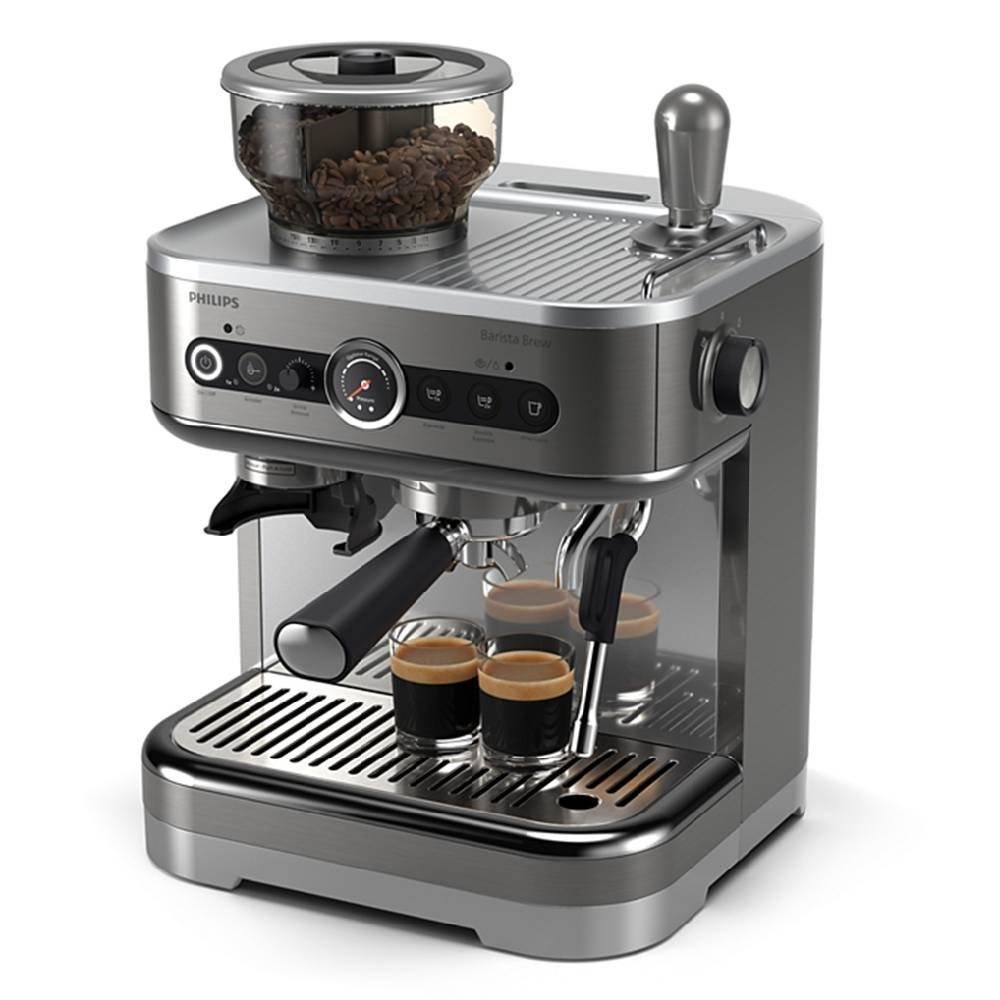
This is the part that trips buyers up, so let’s clear it first. Philips sells the Barista Brew in two machines, each under several model numbers:
| Model | Bean container | US list price (20 Nov 2026) | Who it is for |
|---|---|---|---|
| PSA3218 (suffixes /01, /10, /10R0) | 250 g single hopper | $499.99 | Most buyers — one bean at a time |
| PSA3228 (suffixes /01, /41, /41R0) | 280 g dual hopper | $699.99 | Households that switch beans daily |
The suffixes are the trap. Philips’ own US site lists both PSA3218/10R0 and PSA3228/41R0, Coffeeness reviewed the PSA3218/01, and the US store sells the PSA3228/01. A buying guide published this month found Philips’ own support pages associating some of these suffixes with conflicting manuals and voltages. The practical rule: the first four digits are what matters — 3218 is single-bean, 3228 is dual-bean — and you should check the data label on the bottom of the box for the full type number before you buy.
Everything else about the two machines is the same: the same grinder, the same 58 mm portafilter, the same pump, the same steam wand. You are paying $200 for a divided bean hopper and a temperature-indicator milk jug. For most people, that is not worth $200. Buy the PSA3218.
Street prices are lower than list: Walmart listed the dual-bean model at about $553 on 17 November 2026, and Coffeeness lists an Amazon price of $553.38 for the single-bean model. At that street price, the single-bean machine is a genuinely different value proposition than at $699.99 — always check the current price, because the gap between the two models changes with every sale.
What You Get: Specs That Actually Matter
- 58 mm stainless steel portafilter with single- and dual-wall baskets for 1- and 2-cup shots. This is the headline spec: most machines at this price use a 54 mm portafilter, including the Breville Barista Express. The wider basket gives more even extraction and takes standard 58 mm accessories.
- Built-in metal conical burr grinder, 15 grind settings. Enough range for espresso through to coarser brewing, but with no fine micro-steps — reviewers flag this as the limit for light roasts, where a half-step matters.
- 15-bar pump, 1350 W, 120 V (US). Standard for the class; the pump pressure is not the limiting factor on shot quality.
- 2.3 L (80 fl oz) water tank. Big — you will refill it far less often than the Breville’s 2.0 L tank.
- Calibrated tamper with a countertop-safe tamping system. It clicks when you have pressed hard enough, so tamping — the step beginners get wrong most — is taken out of your hands.
- Americano button and hot water outlet. A real button, not a workaround: it pulls the shot, then adds hot water separately.
- Pressure gauge, intuitive display guidance, 4 brew temperatures. The gauge shows whether your shot is in range; the display walks you through each drink.
- 450 ml milk jug included (temperature-indicator jug on the dual-bean model, standard jug on the single-bean model).
- ~16.1 x 12.5 x 13.1 inches, ~18.9 lbs. A countertop machine, not a compact one — measure your space, especially the height under your cabinets.
- 2-year warranty and 30-day money-back guarantee on Philips’ US store.
How It Brews: Espresso Quality
Every hands-on reviewer consulted for this Philips Barista Brew review agrees on the core point: this machine pulls good espresso for a beginner. HouseholdMe, which tested it daily for four weeks, scored its espresso 8.4 out of 10 — the best espresso score in Philips’ whole range — and found it “rich and sweet” with the unpressurized basket and fresh beans. Tom’s Guide, which tested it for a few weeks, says it pulls “a delicious shot” and “rich, flavorful shots of espresso, even if you’re a beginner.”
The 58 mm portafilter is doing real work here. Combined with the calibrated tamper and the pressurized baskets (which forgive an imperfect grind), the machine is designed to get a new owner to a drinkable shot fast. That is the whole pitch: training wheels that you can remove later by switching to the unpressurized basket once your grind and dose are consistent.
Two honest limits. First, the grinder’s 15 settings have no micro-steps, so dialing in a light roast — where the difference between sour and sweet can be one small adjustment — is harder than on a machine with finer control. Second, the machine’s ceiling is lower than a true prosumer machine: once you can dial in consistently, you will get more out of a machine with adjustable pre-infusion and precise temperature control. That is a “later” problem, not a “first month” problem.
If you are new to espresso, start with our espresso guide and mind your coffee-to-water ratio — ratio affects the cup more than the machine does. And a good burr grinder matters more than any single machine feature; here, at least, the grinder is built in.
The Grinder: Good Enough, With One Catch
The built-in grinder is a metal conical burr unit with 15 settings, from superfine to coarse. For medium and dark roasts, reviewers found it perfectly adequate. The catch is the one already mentioned: no fine steps between settings. Tom’s Guide also notes the grind is on the noisy side, “a little short on grind settings,” with a higher-pitched whine than the low hum of more expensive machines.
Practical advice from the reviews behind this Philips Barista Brew review: start in the middle of the range, adjust one step at a time, and change only one variable per shot. If your shots run fast and sour, go finer; if they choke and drip slowly, go coarser. And keep the hopper sealed — the dual-bean model’s aroma seal is genuinely useful if you buy two beans, but for the single-bean model, just don’t leave beans sitting in the hopper for a week.
Milk Steaming: The Weakest Part
This is where every reviewer in this Philips Barista Brew review marks the machine down. Tom’s Guide calls the milk frother “fiddly,” notes it takes 10–20 seconds before it actually starts steaming, and found the wand harder to use than the Breville’s. HouseholdMe measured about 50 seconds to steam a cappuccino’s worth of milk and scored milk drinks 7.3 out of 10, well below the espresso score.
You can still make good milk drinks — the built-in steamer and the included 450 ml jug will froth milk for lattes and cappuccinos — but expect a learning curve, and don’t expect latte-art microfoam on your first week. If milk drinks are the main reason you are buying, this is the one area where the Breville Barista Express is clearly better. If you mostly drink straight espresso and Americanos, it barely matters.
Philips Barista Brew vs Breville Barista Express
This Philips Barista Brew review puts the comparison every buyer actually makes head-on.
| Philips Barista Brew (PSA3218) | Breville Barista Express | |
|---|---|---|
| US list price | $499.99 | $699.99 |
| Street price (Nov 2026) | ~$553 | ~$684 |
| Portafilter | 58 mm | 54 mm |
| Grinder settings | 15 | 16 |
| Water tank | 2.3 L | 2.0 L |
| Pre-infusion | Fixed | Adjustable |
| Brew temperature control | 4 presets | Degree-by-degree |
| Americano button | Yes | No |
| Power | 1350 W | 1600 W |
| Best for | Beginners who want guidance | Learners who want control |
Coffeeness, which has tested both, concludes the Breville is “superior in all ways but one”: the 54 mm portafilter. The Breville’s adjustable pre-infusion and degree-by-degree temperature control give it a higher ceiling once you know what you are doing, and Coffeeness found it looks and feels more durable and stylish. Tom’s Guide agrees the Breville’s steam wand is more effective and its build feels sturdier, though it smudges more easily.
So why buy the Philips? This Philips Barista Brew review found three reasons: the 58 mm portafilter (standard accessories, better extraction), the bigger water tank, and the price — roughly $130–$150 less at street prices, with the calibrated tamper and guided display doing more hand-holding for a first-timer. The Americano button is a small but real everyday convenience the Breville lacks.
Buy the Philips if: you are new to espresso, you want the machine to guide you, and you would rather spend the $150 you save on good beans. Buy the Breville if: you already know you will chase light roasts and latte art, and you want the machine with the higher ceiling.
If $500 is already stretching the budget, our best espresso machine under $200 guide covers what you give up at that price — and the Ninja Luxe guide is the other machine in this same “guided beginner” category.
Setup and First-Week Troubleshooting
Target reviewers and the hands-on reviews behind this Philips Barista Brew review repeat the same first-week issues. They are all fixable:
- Sour, fast shots: grind finer one step, and check your dose. A sour shot that runs in under 20 seconds is under-extracted, not a broken machine.
- Bitter, slow shots: grind coarser one step. If the shot chokes and barely drips, the grind is too fine for the basket you are using — try the dual-wall (pressurized) basket first.
- Weak, watery Americanos: the Americano button adds hot water after the shot by design. If it tastes thin, pull a double shot instead of a single before adding water.
- Milk not frothing: purge the wand first (let steam run for a few seconds before putting it in the milk), keep the tip just under the surface, and give it the 10–20 seconds it needs to reach full steam. Cold milk, cold jug, better foam.
- Grinder adjustment feels stiff: adjust the grind while the grinder is running, not while it is off — that is standard for built-in grinders and avoids jamming beans between the burrs.
- Narrow water tank: the tank is tall and slim, so fill it at the sink with a jug rather than trying to fit it under the tap. Descale on Philips’ schedule, not when the machine starts tasting off — by then it is late.
Who Should Buy It — and Who Should Not
Buy it if: you are buying your first espresso machine; you want a built-in grinder and a 58 mm portafilter without paying $700; you drink mostly espresso and Americanos; you like the idea of the machine guiding you through each drink.
Skip it if: you already own a decent grinder and want a machine only (you are paying for a grinder you don’t need); you mainly drink milk drinks and want fast, silky steaming; you roast light and want fine grind control; or you can stretch to the Breville Barista Express and want the higher ceiling.
The dual-bean PSA3228 is worth it only if you genuinely keep two beans on hand — say, a decaf and a regular, or a dark roast for milk drinks and a light roast for straight shots — and switch between them most days. Otherwise the $200 buys you a divided hopper you will use as a single hopper.
The Verdict
The Philips Barista Brew is a good beginner espresso machine at a fair price — not a giant-killer, and not the best machine in its class, but an honest one, as this Philips Barista Brew review has shown. Its strengths are exactly the ones a first-time buyer needs: a 58 mm portafilter, a forgiving pressurized basket, a calibrated tamper, and a display that walks you through the drink. Its weaknesses are the ones a first-time buyer will notice last: no fine grind steps and a slow, fiddly steam wand.
At the single-bean model’s street price of around $553, it earns its place. At the dual-bean model’s $699.99 list price, it does not — at that money, buy the Breville Barista Express instead. And if you are still deciding between hands-on espresso and push-button convenience, our AeroPress vs French Press comparison is the low-budget way to find out which kind of coffee drinker you are before spending $500 on a machine.
Prices and model details in this Philips Barista Brew review were checked 20 November 2026 on Philips’ US store and in the hands-on reviews linked above. Check the live price before you buy.
Frequently Asked Questions
What is the difference between the Philips Barista Brew PSA3218 and PSA3228?
The PSA3218 is the single-bean model (250 g hopper, $499.99 list); the PSA3228 is the dual-bean model (280 g divided hopper, $699.99 list). Everything else — grinder, portafilter, pump, steam wand — is the same. The suffixes (/01, /10, /41, /R0) are regional and retailer variants of the same two machines.
Is the Philips Barista Brew worth it vs the Breville Barista Express?
For a beginner, yes — this Philips Barista Brew review finds it worth it at the Philips’ street price (~$553 vs ~$684 for the Breville). You get a bigger portafilter, a bigger tank, an Americano button and more guidance for less money. The Breville wins on control — adjustable pre-infusion, degree-by-degree temperature — and steaming, so it is the better buy if you plan to go deep into espresso.
Does the Philips Barista Brew make real espresso?
Yes — as this Philips Barista Brew review explains, it is a semi-automatic with a 15-bar pump and a 58 mm portafilter, pulling real espresso shots. With the unpressurized basket, fresh beans and a correct grind, reviewers found the shots rich and sweet. The pressurized basket is the beginner-friendly option while you learn.
How many grind settings does the Philips Barista Brew have?
15 settings on a metal conical burr grinder. That covers espresso to coarser brewing, but there are no fine micro-steps, which makes dialing in light roasts harder than on machines with finer adjustment.
Is the milk steamer any good?
It works, but it is the machine’s weakest feature: slow to pre-heat (10–20 seconds before steam starts), about 50 seconds to steam a cappuccino’s milk, and fiddly to learn. Fine for occasional milk drinks; a weak point if milk drinks are your main drink.
What comes in the box?
The machine, 58 mm stainless steel portafilter, 1- and 2-cup single- and dual-wall filter baskets, stainless steel calibrated tamper, and a 450 ml milk jug (temperature-indicator jug on the dual-bean model, standard jug on the single-bean model). Philips’ US store lists a 2-year warranty and 30-day money-back guarantee.