AeroPress vs French Press: Which One Should You Actually Buy?

If you are choosing your first serious coffee brewer, the aeropress vs french press question comes up fast. Both use immersion brewing: the grounds sit in hot water while flavor is extracted. Both are simple, with no machine and no complicated setup. Yet the cups they make are not the same, and the person each one fits best is not the same either.
This guide compares them on taste, brew time, servings, cleanup, cost, portability, and grind size. The short version: for a clean, bright, single cup with very little sediment, the AeroPress has the edge. For a bold, full-bodied cup, especially for more than one person, the French press has the edge.
What Is an AeroPress?
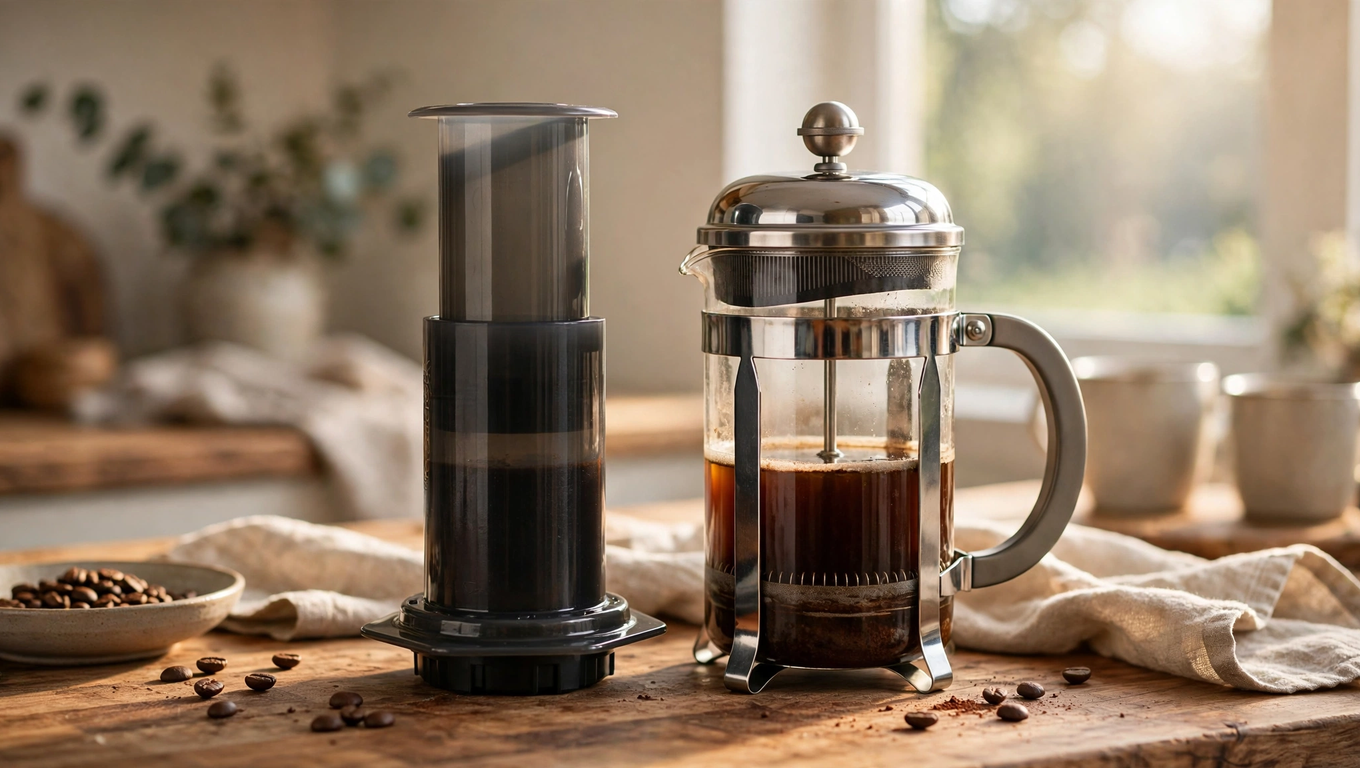
The AeroPress was invented in 2005 by Alan Adler, a Stanford engineer who was also behind the Aerobie flying disc. It combines immersion brewing with gentle hand air pressure to push coffee through a paper micro-filter.
In use, grounds and hot water sit together in a chamber, then the brewer is pressed down so the coffee passes through the filter into a cup below. The pressure is modest, around 0.5–0.75 bar, far below the 9 bar a real espresso machine uses, so it does not make true espresso, though it can make a strong, concentrated cup.
A standard brew uses a medium-fine grind, a typical dose of 14–20 g of coffee, and 200–230 ml of water, at a ratio of about 1:15–1:16. It brews in 1–2 minutes and makes one cup at a time. A reusable metal filter is available separately, but the paper micro-filter is standard. Learn more at the AeroPress official site.
What Is a French Press?
The French press is the older brewer. Its design was patented in 1929 by Italian designer Attilio Calimani, and a refined version was patented in 1958 by Faliero Bondanini. Its method has barely changed: grounds steep in hot water, then a metal mesh filter is pressed down to separate the grounds from the finished coffee.
The grounds stay in contact with the water for the full steep, about four minutes, giving a cup with a heavier body and a fuller, more direct flavor. The brewer uses a coarse grind and a ratio of about 1:15, and it brews 3–8 cups at once, depending on its size.
The metal mesh lets coffee oils and fine particles through into the cup. Those oils add richness and weight, but the fine particles also mean some sediment can settle at the bottom. That is the natural result of the filter, and part of the trade-off of this style. For a step-by-step method, see how to make French press coffee at home.
AeroPress vs French Press: Head-to-Head Comparison
| Feature | AeroPress | French Press |
|---|---|---|
| Brew method | Immersion plus gentle hand air pressure through a paper micro-filter | Full immersion with a metal mesh filter pressed down to separate grounds |
| Taste | Clean, bright, and smooth, with little or no sediment | Bold, full-bodied, and rich, with a heavier mouthfeel and some sediment |
| Brew time | 1–2 minutes | About 4 minutes of steeping |
| Servings | 1 cup at a time | 3–8 cups at once |
| Cleanup | Quick: remove the filter and used grounds, then rinse | Slower: grounds must be removed from the mesh and vessel, then rinsed |
| Portability | Compact single-cup brewer, easy to pack and carry | Larger multi-cup brewer, better suited to staying at home |
| Ongoing filter cost | Paper filters are an ongoing cost, unless a reusable metal filter is used | No paper filters to buy; the metal mesh is reused |
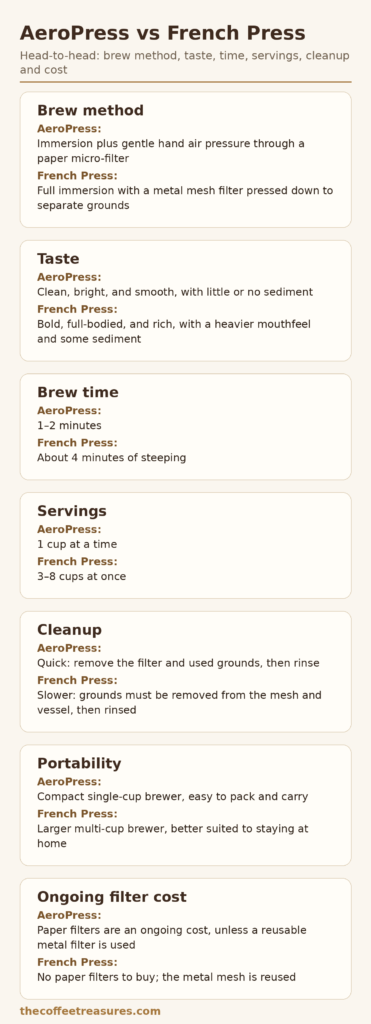
That table is the heart of the aeropress vs french press comparison.
Taste: Clean and Bright vs Bold and Full-Bodied
Taste is where the two brewers differ most clearly. The AeroPress pushes coffee through a paper micro-filter, and paper filters trap oils and fine particles. The result is a clean cup with no sediment, a smoother texture, and a brighter, clearer flavor.
The French press works in the opposite way. Its metal mesh keeps the oils in the cup and lets fine particles through, giving a richer, heavier mouthfeel and a bolder, more full-bodied flavor. The trade-off is some sediment at the bottom, and a last sip that can feel gritty.
Neither style is better in an absolute sense. If you like a clean, bright cup, the AeroPress will suit you. If you like a bold, full-bodied cup, the French press will suit you. When people ask about aeropress vs french press taste, this filter difference is the answer that matters most.
Brew Time
An AeroPress brews in 1–2 minutes: add the coffee and water, let it steep briefly, press, and the cup is ready. For a single drinker who wants coffee quickly, that speed is a real advantage.
A French press takes longer, with a steep of about four minutes — roughly twice as long. The extra time is part of what gives French press coffee its full body, but you do need to plan a little further ahead. If you make coffee while doing something else in the kitchen, the four-minute steep may not feel slow at all.
Servings: One Cup or Several?
Servings may be the most decisive difference, because it is the one you cannot work around. An AeroPress makes one cup at a time. That is fine if you live alone or are the only coffee drinker in the house, but less fine if two or three people all want coffee at the same time.
A French press brews 3–8 cups at once, depending on its size — a natural fit for a household, a shared breakfast, or a small group. One brew serves everyone, and nobody is left waiting. Think about your normal morning: one person means the AeroPress limit does not matter; two or more people together means the French press capacity is a genuine advantage.
Cleanup
Cleanup is a smaller difference than taste or servings, but you will notice it every day. The AeroPress is easier to clean: the paper filter and used grounds can be removed in one step, and the brewer can be rinsed. There is no mesh to scrub and no large vessel full of wet grounds to empty.
The French press takes more effort. The grounds sit in the vessel behind the metal mesh, and they need to be removed before the brewer can be rinsed. The mesh needs attention too, because fine grounds can cling to it. It is slower and messier, so if you value a fast, tidy finish, the AeroPress has a clear edge.
Cost, Including Ongoing Paper-Filter Cost
Both brewers are simple devices with no electronics, so the upfront cost of either one is modest compared with a coffee machine. This guide does not state a price for either brewer, because prices vary by size, model, and retailer.
The AeroPress uses paper micro-filters, an ongoing cost. Each brew uses one, so the cost is small per cup but real over time. A reusable metal filter is available separately and removes that cost, but it also changes the cup, because a metal filter lets more oils through. If you want the clean, bright cup described here, expect to keep buying paper filters.
The French press has no paper filters to buy. Its metal mesh filter is reused brew after brew, so there is no ongoing filter cost at all.
Portability
The AeroPress is a compact, single-cup brewer that is easy to pack and carry — a natural fit for travel, a small kitchen, or an office desk.
The French press is a larger, multi-cup brewer, better suited to staying at home. Its size and capacity make it less convenient for travel. Its strength is at home, where it can sit on the counter and brew for several people. If you travel often, the AeroPress is more practical. If your coffee is almost always made at home, portability may not matter at all.
Grind Size
Grind size is not a detail to skip, because the wrong grind is one of the easiest ways to get a disappointing cup. The two brewers need different grinds, and the reason is the filter each one uses.
The AeroPress uses a medium-fine grind. The finer grind suits its short 1–2 minute brew time, because a finer grind extracts flavor faster, and it suits its paper micro-filter, which can hold back fine particles and keep the cup clean. Too coarse a grind can lead to a weak, under-extracted cup.
The French press uses a coarse grind. The coarser grind suits its longer, four-minute steep, and its metal mesh filter, which holds back coarse grounds while letting oils through. Too fine a grind can lead to a muddy, gritty cup.
If you already own a grinder, check whether it can grind at both settings, and read the site’s guide to the best coffee grinders before you buy one. For a gentler introduction to manual brewing, see the pour-over coffee for beginners guide.
The Filter Explainer: The One Sentence That Decides the Comparison
If you remember only one idea from this guide, remember this: a paper filter traps oils and fine particles to make a clean, bright cup, while a metal mesh filter keeps the oils to make a rich, heavy cup.
That single sentence decides the aeropress vs french press comparison for most people, because it explains why the two brewers taste different even when they use the same coffee and a similar ratio. They are two different ways of filtering the same brew. Choose the filter, and you have largely chosen the brewer.
Which One Should You Buy? A Decision Framework
Match the brewer to the way you live and drink, not to a list of features.
Solo drinker — buy the AeroPress. If you are the only coffee drinker in your household, it makes one clean cup quickly, with little cleanup, and you never brew more than you need.
Household — buy the French press. If two or more people drink coffee together, or you often have guests, one brew serves everyone, and nobody waits for a second round.
Traveler — buy the AeroPress. If you want good coffee on the road, in a small kitchen, or at your desk, it is easier to carry, store, and use in a small space.
Tinkerer — buy the AeroPress. If you enjoy changing one variable at a time, its short brew time, medium-fine grind, and paper filter reward small adjustments.
Simplest routine — buy the French press. If you want one brewer, one method, and no ongoing filter cost, it is the simpler long-term choice.
Still cannot decide? Ask yourself: how many cups do you need at once, and do you prefer a clean cup or a bold cup? One cup and clean means AeroPress. Several cups and bold means French press. In between, use the filter as your tie-breaker: paper means clean and bright, mesh means rich and heavy.
Common Beginner Mistakes (and the Fix for Each)
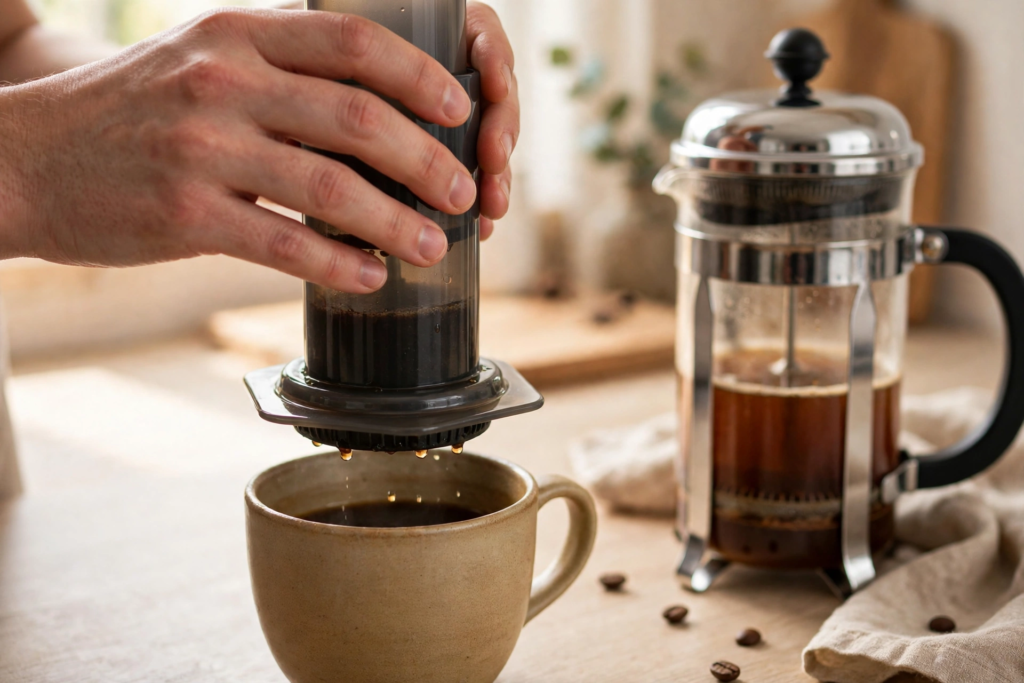
Pressing the AeroPress too hard. The press should take about 20–30 seconds of steady, gentle pressure. Forcing it down fast pushes fine grounds through the filter and makes a bitter, gritty cup. If the press feels stuck, the grind is too fine — go coarser rather than pushing harder.
Letting French press coffee sit after plunging. Once you press the mesh down, the coffee keeps extracting from the grounds trapped below it. Pour it out into cups or a carafe right away — a French press left standing for ten minutes tastes noticeably more bitter than one poured immediately.
Plunging the French press too fast. A fast plunge stirs the settled grounds back up into the cup. Press down slowly and steadily, and stop if you feel strong resistance — that means the grind is too fine.
Grinding too fine for the French press. A fine grind makes a muddy cup, clogs the mesh, and makes plunging hard. If the plunger fights you, the grind is the problem, not the press.
In the end, the aeropress vs french press choice is decided as much by these daily habits as by taste — the brewer you enjoy using is the one you will keep using.
Frequently Asked Questions
Which is better for beginners, AeroPress or French Press?
Both suit beginners, because neither needs a machine or a complicated technique. The French press is arguably simpler: add coffee and water, wait about four minutes, and press the mesh down. The AeroPress is also straightforward, but pressing by hand and using a paper filter adds one small step. Easiest start: French press; fastest cup: AeroPress.
Which makes stronger coffee?
Strength depends on the ratio of coffee to water and on how long the grounds stay in contact with the water, not on the brewer alone. An AeroPress can make a strong, concentrated single cup, using a medium-fine grind and a ratio of about 1:15–1:16, with a typical dose of 14–20 g. A French press can also make a strong cup, steeping for about four minutes at a ratio of about 1:15. Neither is automatically stronger; the difference is style.
Which is easier to clean?
The AeroPress is easier to clean. Its paper filter and used grounds can be removed in one step, and the brewer can be rinsed quickly. The French press takes more effort, because the grounds must be removed from the vessel and the metal mesh needs rinsing. Both are easy compared with a coffee machine, but the AeroPress is quicker.
Do I need to keep buying paper filters for an AeroPress?
Yes, if you want the clean, bright cup that a paper micro-filter makes. Each brew uses one paper filter, so they are an ongoing cost. A reusable metal filter is available separately and removes that cost, but it changes the cup, because a metal filter lets more oils through.
Can an AeroPress make espresso?
No, an AeroPress does not make true espresso. It uses gentle hand air pressure of around 0.5–0.75 bar, far below the 9 bar a real espresso machine uses. It can make a strong, concentrated cup, sometimes described as espresso-style, but it is not espresso in the technical sense.
Which tastes better — clean and bright, or bold and full-bodied?
Neither tastes better in an absolute sense, because taste is personal. A clean and bright cup, made with a paper filter, is smoother, clearer, and free of sediment. A bold and full-bodied cup, made with a metal mesh filter, is richer, heavier, and more direct. If you like clean, smooth coffee, choose the AeroPress. If you like rich, heavy coffee, choose the French press.
Final Verdict: AeroPress vs French Press in 2026
The aeropress vs french press decision is not a contest between a good brewer and a bad one. Both are proven, simple, and capable of a very good cup. The right answer depends on how you drink coffee, how many people you brew for, and how much time and cleanup you want.
Choose the AeroPress if you drink alone, want a clean, bright cup with no sediment, want coffee ready in 1–2 minutes, and are happy to keep buying paper filters. Choose the French press if you brew for a household, want a bold, full-bodied cup, are happy to wait about four minutes, and want no ongoing filter cost.
If you are still torn, let the filter decide: paper means clean and bright, mesh means rich and heavy. Pick the cup you want tomorrow morning, and buy the brewer that makes it.