Why Does My Pour Over Taste Bitter? (Plus Sour, Weak, and Other Fixes)

If you have ever asked yourself why does my pour over coffee taste bitter, you are not alone. Pour over is one of the most rewarding ways to brew coffee at home, but it is also one of the easiest to get slightly wrong. The good news is that a bitter cup is rarely a mystery. In most cases, bitterness is a sign of over-extraction: the water has pulled too much out of the coffee grounds, reaching the harsh, bitter compounds that come out last. Once you know what to look for, a few small adjustments are usually enough to turn a bitter cup into a balanced one.
Quick Diagnostic: What Your Cup Is Telling You
Before changing anything, taste your coffee and match it to the table below. The symptom points to the likely cause, and the first fix is the single change to try in your next brew.
| Symptom | Likely cause | First fix |
|---|---|---|
| Bitter, harsh, dry aftertaste | Over-extraction: grind too fine, water too hot, or brew time too long | Go one step coarser on the grind |
| Sour, sharp, or vinegary | Under-extraction: grind too coarse or water too cool | Go one step finer on the grind |
| Weak and watery | Too little coffee for the water, or extraction too low | Add more coffee (move toward a 1:15 ratio) |
| Bitter AND sour at the same time | Uneven extraction / channeling: some grounds over-extracted, others under-extracted | Check your grind consistency and pour evenly; a burr grinder helps |
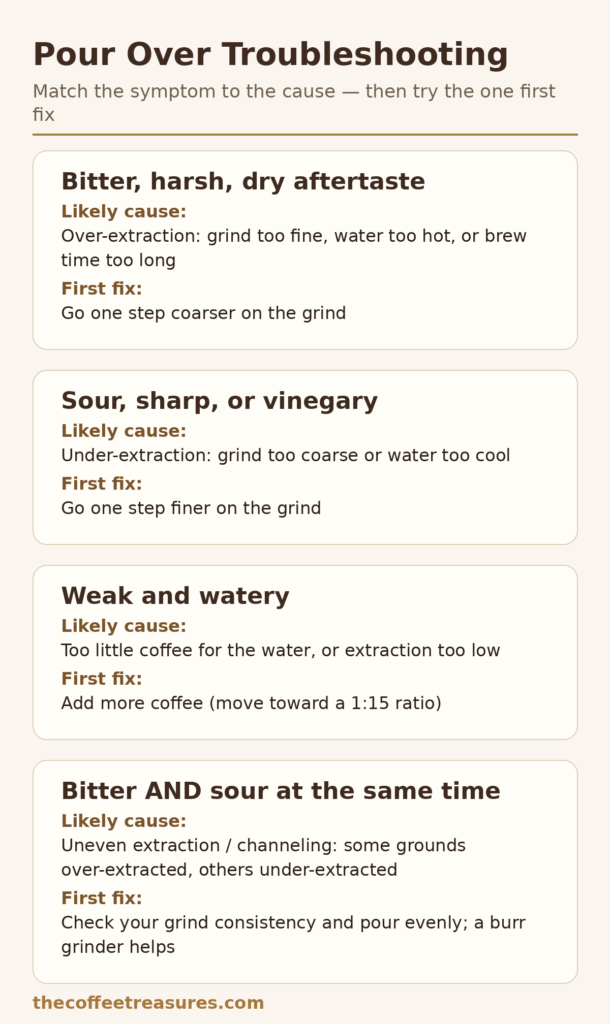
Almost every pour over problem falls into one of these four rows, and the fix is almost always smaller than you expect.
How Extraction Works (The 30-Second Version)
Good pour over lives in a narrow window. Brewing guides generally recommend that about 18–22% of the coffee’s mass should dissolve into the water. Below that range, the cup tastes sour or underdeveloped. Above it, the cup turns bitter and astringent. Pour over troubleshooting is really just the work of landing inside that window — and staying there.
Every variable in this guide — grind, water temperature, ratio, and pour — is a lever that moves your extraction up or down. Move one lever at a time, so you know which one fixed the problem.
Why Does My Pour Over Coffee Taste Bitter? The Causes, in Order
Work through these in the order listed. They are ranked from most likely to least likely.
1. Your Grind Is Too Fine
This is the most common reason a pour over tastes bitter, and it is the first thing to check.
A finer grind means more surface area, and more surface area means the water extracts flavor compounds faster and more deeply — including the bitter ones that come out late in the brew. A fine grind also slows the water down, stretching the total brew time and pushing extraction even higher.
The one fix to try first: go one step coarser on your grinder. Aim for a medium-coarse grind, about the texture of sea salt. Brew one cup with that single change and taste it before touching anything else. If the bitterness drops but the cup now leans sour, you went a little too far — split the difference next time.
2. Your Water Is Too Hot
Water temperature is the second most common cause of bitterness, and it is easy to overlook because boiling water feels like the obvious choice.
The Specialty Coffee Association recommends a brewing water range of 195–205°F (90–96°C). Above 205°F, water scalds the grounds and over-extracts them, pulling out harsh, bitter flavors. Water straight from a rolling boil is 212°F (100°C) — too hot for pour over.
The one fix to try first: let boiled water sit for 30–45 seconds before you pour, which brings it down to about 200°F, right in the middle of the recommended range. For more on the source of this range, see the Specialty Coffee Association.
3. Your Ratio Uses Too Much Coffee
The coffee-to-water ratio is the third lever. Too much coffee relative to the water does not just make a stronger cup — it concentrates every flavor, including the bitter ones. A heavy dose can taste harsh even when the grind and temperature are right.
Brewing guides generally recommend a golden ratio of 1:16 — one gram of coffee for every 16 grams of water. For a bolder cup, try 1:15; for a lighter cup, try 1:17. A simple starting point is 20 g of coffee to 320 g of water.
The one fix to try first: weigh your coffee and water, and move to a 1:16 ratio if you have been brewing by eye. If the cup is still too strong and bitter at 1:16, try 1:17 next. Too little coffee, by contrast, gives weak, sour results — so if your cup is both bitter and thin, the ratio is worth checking before anything else.
4. Your Pour Technique and Drawdown Speed
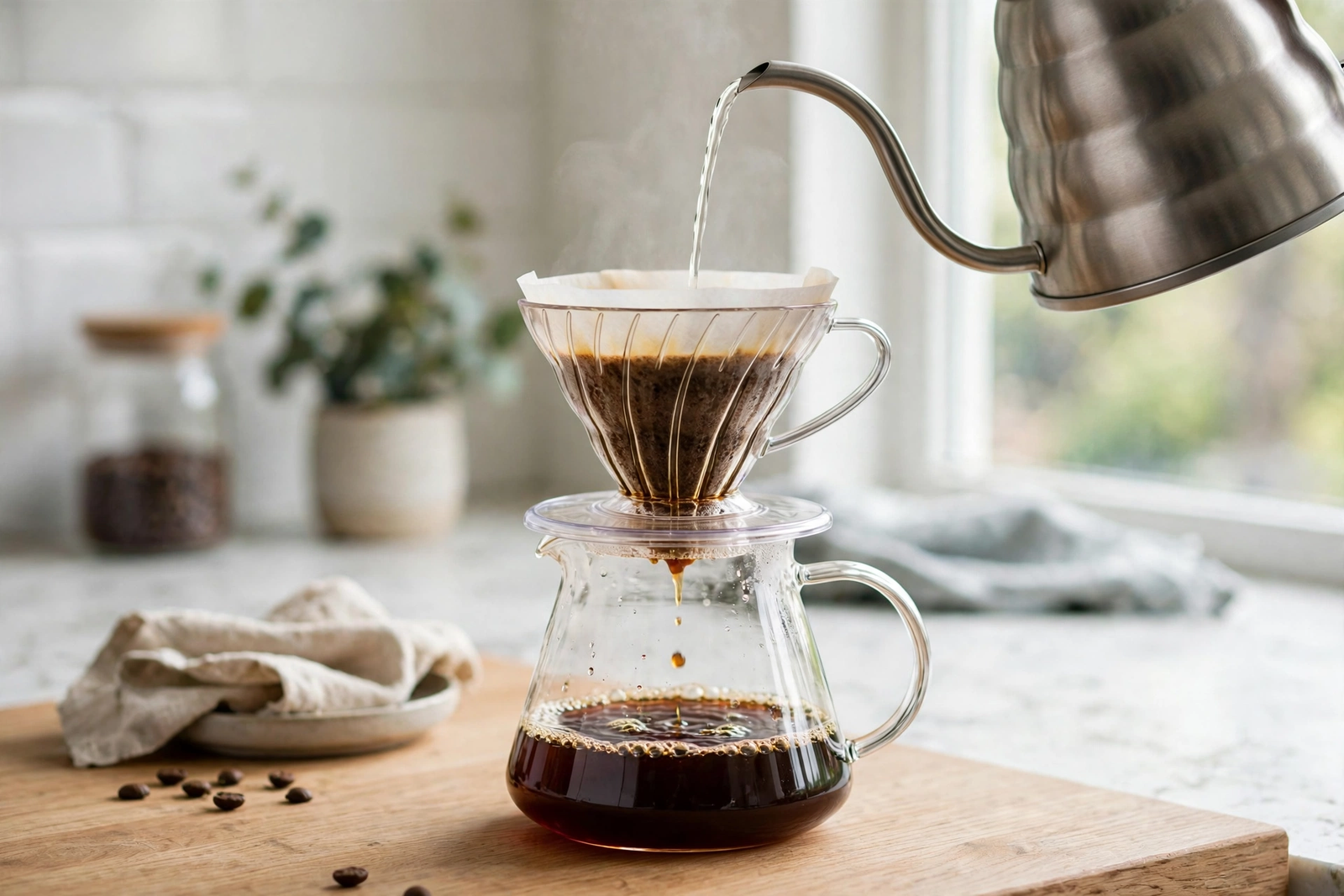
The pour itself is the fourth cause, and it shows up most clearly in the drawdown — how fast the water passes through the grounds and into the carafe.
For a V60-style pour over, brewing guides generally recommend a total brew time of about 2:30–3:30 minutes. Beyond 4 minutes, the water has been in contact with the grounds too long, and over-extraction becomes likely.
Here is the key relationship: for pour over, grind size controls drawdown speed. A finer grind slows the water down; a coarser grind lets it pass through faster. So if your brew is dragging past 4 minutes, the real problem is usually the grind, not your pouring arm.
Two parts of the pour deserve attention:
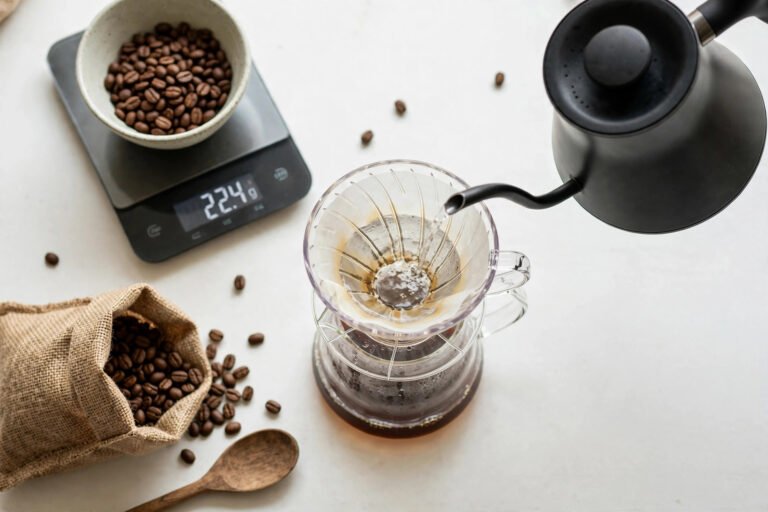
- The bloom. Pour a little water first and let the grounds bloom for 30–45 seconds before the main pour. The bloom releases trapped gas from the grounds and helps the water extract evenly. Skipping it can leave parts of the bed under-extracted while others over-extract — one route to a cup that tastes both bitter and sour.
- The main pour. Pour slowly and evenly, in steady circles, keeping the water level consistent rather than flooding the bed and letting it drain dry. An uneven pour can create channels — paths where water rushes through some grounds and barely touches others — which is the classic cause of uneven extraction.
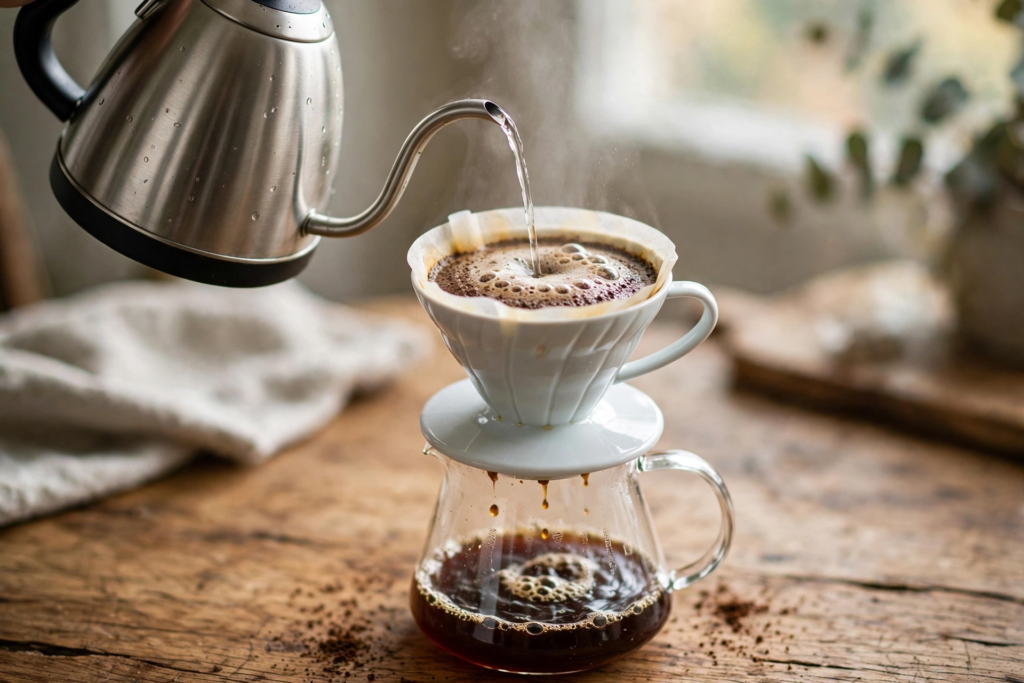
The one fix to try first: time your next brew. Over 4 minutes means the grind is too fine — go coarser. Well under 2:30 with a sour or weak cup means go finer. The clock is the cheapest diagnostic tool you own.
5. Your Beans and Water — the Last Resort
If the grind, temperature, ratio, and pour are all in range and the cup is still bitter, the beans or the water may be contributing. But do not blame the beans first. Very dark roasts extract more easily and can taste bitter in a pour over even with correct technique, and very hard tap water can flatten or distort flavor. Both are worth checking — eventually. In practice, most bitter pour over cups are fixed by one of the four causes above.
The one fix to try first: check your drawdown time. If it is slow, the grind is the problem, not the beans. Only after grind, temperature, ratio, and pour are all in range should you try a different roast or filtered water.
If you are still building your pour over setup, our pour over coffee for beginners guide walks through the equipment and the basic method step by step.
What NOT to Do First
When a cup tastes wrong, the temptation is to fix everything at once. Resist it.
Do not change grind, temperature, and ratio all at once
If you change three variables in one brew and the cup improves, you have no idea which change did it — and you cannot repeat the result reliably. Change only one variable at a time when diagnosing. Brew, taste, adjust one thing, and brew again. It feels slow, but it is the fastest route to a consistently good cup.
Do not buy new beans or new gear before checking drawdown speed
A new bag of coffee or a new dripper feels like progress, but if your grind is too fine and your drawdown is running past 4 minutes, new beans will taste bitter too. Time one brew first. If the drawdown is slow, the fix is a coarser grind — free, and available right now. A burr grinder is worth considering over time, because blade grinders create uneven particles that lead to uneven extraction. If you are weighing an upgrade, our guide to the best coffee grinders explains what to look for.
The Step-by-Step Fix Order
Here is the whole process in one list. Start at step 1 and stop as soon as the cup tastes balanced — most people never get past step 3.
- Time your brew. If the total brew time is over 4 minutes, your grind is almost certainly too fine. Go one step coarser and brew again.
- Check your water temperature. If you have been pouring straight off a rolling boil, let the water sit 30–45 seconds after boiling so it lands near 200°F.
- Weigh your ratio. Move to 1:16 (for example, 20 g coffee to 320 g water). If the cup is still too strong, try 1:17; if it is weak, try 1:15.
- Bloom and pour evenly. Bloom for 30–45 seconds, then pour slowly in steady circles, keeping the water level even.
- Only now, look at beans and water. If everything above is in range and the cup is still off, try a lighter roast or filtered water — one at a time.
One variable per brew, one brew per change. That discipline is the whole secret of pour over troubleshooting.
Keep a Simple Brew Log (Three Brews Is Enough)
If you keep asking why does my pour over coffee taste bitter, a brew log is the fastest way to a real answer. Write down four things after each brew: grind setting, water temperature, ratio, and total brew time — plus one word for the taste (bitter, sour, balanced). Three or four brews is usually enough to see the pattern: if every bitter cup ran past 4 minutes, the grind is the problem; if every sour cup used cooler water, temperature is the problem.
A notebook or a phone note works fine. The point is not to collect data — it is to stop guessing. Most brewers who log three cups find the fix on the fourth.
FAQ: Pour Over Troubleshooting
Why does my pour over coffee taste bitter?
Bitterness in pour over almost always means over-extraction — the water pulled too much out of the grounds, past the 18–22% sweet spot, and into the harsh compounds that extract last. The most likely causes, in order, are a grind that is too fine, water that is too hot (above 205°F), too much coffee for the water, or a brew that ran longer than about 4 minutes. Start by going one step coarser on the grind, then check your water temperature.
Why does my pour over taste sour?
Sourness usually means under-extraction — the water did not pull enough out of the grounds, so the cup tastes sharp or vinegary instead of sweet and balanced. The most common cause is a grind that is too coarse, which gives the water too little surface area to work with. Water that is too cool can do the same thing. Go one step finer on the grind and make sure your water is in the 195–205°F (90–96°C) range.
Why is my pour over coffee weak and watery?
A weak, watery cup usually comes down to too little coffee for the water, or extraction that is too low overall. Check your ratio first: brewing guides generally recommend 1:16, or 20 g of coffee to 320 g of water. If you have been brewing by eye, weighing your dose is often the whole fix. A grind that is far too coarse can also leave the cup thin — in that case, go a step finer as well.
Why does my coffee taste bitter AND sour at the same time?
A cup that is bitter and sour at once is the signature of uneven extraction. Some grounds over-extracted (the bitter part) while others under-extracted (the sour part), usually because water channelled through the bed instead of passing through it evenly. The usual culprits are an uneven grind — blade grinders create a mix of fine and coarse particles — or an uneven pour. A burr grinder gives a more consistent grind, and a slow, even pour with a proper 30–45 second bloom helps the water reach all the grounds equally.
What grind size should I use for pour over?
Brewing guides generally recommend a medium-coarse grind for pour over, about the texture of sea salt. Grind size is also your main control over drawdown speed: finer slows the water down, coarser lets it pass faster. If your total brew time runs past 4 minutes, go coarser; if it finishes well under 2:30 and tastes sour, go finer. The target total brew time for a V60 is about 2:30–3:30 minutes. For grinder recommendations, see our guide to the best coffee grinders.
What water temperature is best for pour over?
The Specialty Coffee Association recommends 195–205°F (90–96°C). Water hotter than 205°F scalds the grounds and over-extracts, which tastes bitter; water much cooler than 195°F under-extracts, which tastes sour. Boiling water straight from the kettle is 212°F (100°C), so let it sit for 30–45 seconds after boiling to cool to about 200°F. A practical target is right around 200°F, in the middle of the range.
Do I need to bloom the coffee?
Yes — blooming is worth the extra 30–45 seconds. Pour a little water first and let the grounds bloom before the main pour. The bloom releases trapped gas from the grounds and lets the water wet them evenly, which leads to more even extraction. Skipping the bloom is one way to end up with a cup that tastes both bitter and sour, because some grounds extract well while others barely get wet.
The Bottom Line on Bitter Pour Over
If you remember one thing from this guide, make it this: bitter pour over is almost always over-extraction, and over-extraction is almost always fixable with one small change. Go coarser on the grind, bring the water into the 195–205°F range, weigh your coffee to a 1:16 ratio, and keep the total brew time around 2:30–3:30 minutes. Change one variable at a time, taste each brew, and let the cup tell you what to do next.
So the next time you catch yourself wondering why does my pour over coffee taste bitter, start with the clock and the grinder — not with a new bag of beans. Pour over rewards patience and small adjustments, and once your brew lands in that 18–22% extraction window, the same coffee you have been fighting with can taste sweet, clear, and balanced. If you also brew with a drip machine, the same principles of grind, temperature, and ratio apply — our guide on how to brew drip coffee at home covers that method in detail.
Happy brewing — and trust the process, one variable at a time.