Coffee to Water Ratio Chart: Grams, Tbsp & Scoops

“How much coffee per cup?” is the most-asked question in home brewing — and the most overcomplicated. Here is the short answer: use about 2 level tablespoons of ground coffee (roughly 10–11 grams) for every 6 ounces of water, or about 15 grams per 8-ounce mug. That is the coffee world’s “golden ratio” territory, and it works as a starting point for almost every brew method.
Below is the full coffee to water ratio chart for 1 to 12 cups in grams, tablespoons, and scoops, plus the right ratio for each brew method, so you never have to guess again.
What “coffee to water ratio” actually means
A coffee to water ratio is a weight ratio: the weight of dry ground coffee compared to the weight of the brewing water. It is always written coffee first, water second — 1:16 means 1 gram of coffee for every 16 grams of water.
Water makes this easy, because 1 milliliter of water weighs about 1 gram. So 240 ml of water (one 8-ounce mug) weighs about 240 grams, and at a 1:16 ratio you need 240 ÷ 16 = 15 grams of coffee.
One thing trips up every beginner: the numbering runs opposite to intuition. A lower second number means more coffee and a stronger cup. So 1:14 is stronger than 1:18. Remember “coffee first, water second” and it stops being confusing.
The golden ratio, explained without the jargon
- The National Coffee Association calls the “golden ratio” one to two tablespoons of ground coffee for every six ounces of water — the kitchen-friendly version.
- The Specialty Coffee Association sets its Golden Cup Standard at 55 grams of coffee per liter of water, which works out to roughly 1:18.
In practice, most specialty brewers land between 1:15 and 1:18, with 1:16 as the balanced middle that suits drip and pour-over especially well. Neither the NCA nor the SCA figure is “wrong” — they are starting points, and you adjust to taste from there. The chart below uses 1:16 throughout.
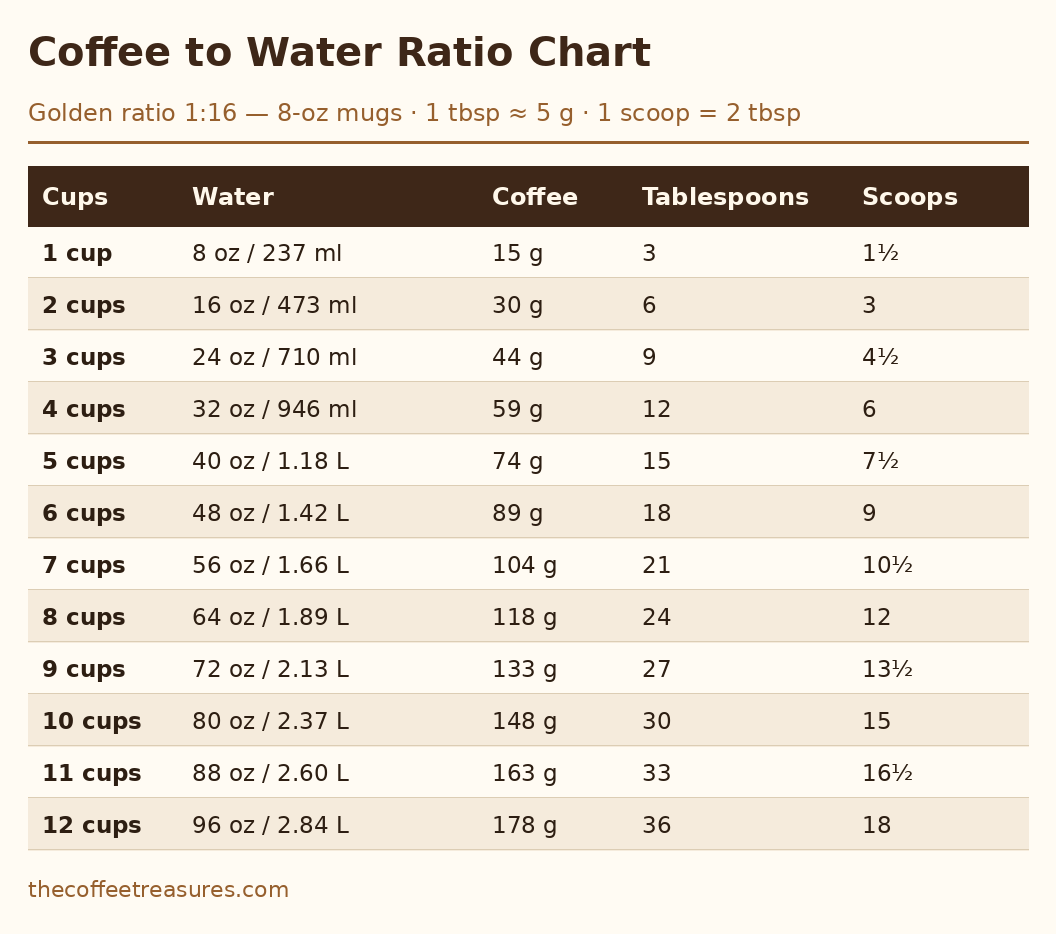
Coffee to water ratio chart: 1 to 12 cups (at 1:16)
This chart uses standard 8-ounce mugs. A few conversions behind the math: 1 ml of water ≈ 1 g; one level tablespoon of medium-ground coffee weighs about 5 grams (it varies 5–7 g by grind and bean, which is why a scale wins — more on that below); one standard coffee scoop holds 2 tablespoons, about 10 grams. Amounts are rounded to keep them usable.
| Cups (8 oz mugs) | Water | Coffee (grams) | Tablespoons | Scoops |
|---|---|---|---|---|
| 1 | 8 oz / 237 ml | 15 g | 3 | 1½ |
| 2 | 16 oz / 473 ml | 30 g | 6 | 3 |
| 3 | 24 oz / 710 ml | 44 g | 9 | 4½ |
| 4 | 32 oz / 946 ml | 59 g | 12 | 6 |
| 5 | 40 oz / 1.18 L | 74 g | 15 | 7½ |
| 6 | 48 oz / 1.42 L | 89 g | 18 | 9 |
| 7 | 56 oz / 1.66 L | 104 g | 21 | 10½ |
| 8 | 64 oz / 1.89 L | 118 g | 24 | 12 |
| 9 | 72 oz / 2.13 L | 133 g | 27 | 13½ |
| 10 | 80 oz / 2.37 L | 148 g | 30 | 15 |
| 11 | 88 oz / 2.60 L | 163 g | 33 | 16½ |
| 12 | 96 oz / 2.84 L | 178 g | 36 | 18 |
One detail worth knowing: ratios always count the water you pour in, not the coffee you drink. Grounds absorb water during brewing, so 500 ml poured in yields a bit less than 500 ml in the cup.
Wait — is your “cup” 6 ounces or 8 ounces?
This is the single biggest source of ratio confusion. A coffee maker’s “cup” is not an 8-ounce mug — carafe markings are usually 5 or 6 ounces. A “12-cup” pot therefore holds 60–72 ounces of water, not 96. If your coffee has ever tasted weak from a drip machine, this mismatch is the likely culprit.
Here is the same 1:16 ratio translated to carafe cups:
| Coffee maker size | Water | Coffee (grams) | Tablespoons | Scoops |
|---|---|---|---|---|
| 4-cup pot (5 oz cups) | 20 oz / 591 ml | 37 g | 7 | 3½ |
| 8-cup pot (5 oz cups) | 40 oz / 1.18 L | 74 g | 15 | 7½ |
| 10-cup pot (5 oz cups) | 50 oz / 1.48 L | 92 g | 18 | 9 |
| 12-cup pot (5 oz cups) | 60 oz / 1.77 L | 111 g | 22 | 11 |
| 12-cup pot (6 oz cups) | 72 oz / 2.13 L | 133 g | 27 | 13½ |
Check your carafe: if the markings say 6 oz per cup, use the last row; most machines mark 5 oz cups. When in doubt, measure the water you actually pour in — that is the only number the ratio cares about.
Coffee to water ratio by brew method
Different methods extract differently, so each has its own starting range. Pick the middle of your method’s range first, then adjust by taste.
| Brew method | Ratio (coffee : water) | What that looks like |
|---|---|---|
| Drip / automatic brewer | 1:15 – 1:17 | 15–16 g per 8 oz mug — see our drip coffee guide |
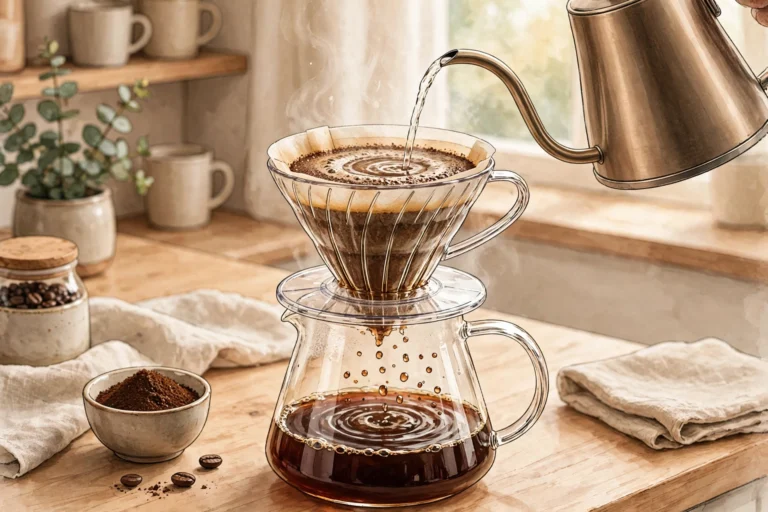
| Pour-over (V60, Chemex) | 1:15 – 1:17 | 20 g coffee to 320–340 g water — see our pour-over guide for beginners |
| French press | 1:12 – 1:15 | 30 g to 360–450 g; immersion extracts more, so a slightly tighter ratio suits it — see our French press guide |
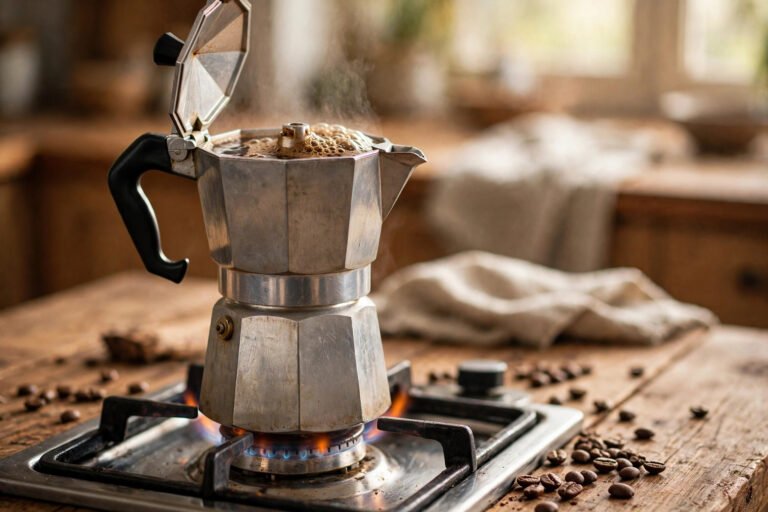
| Moka pot | 1:8 – 1:10 | Fill the basket level, water to just below the valve, never tamp — see our moka pot guide |
| Cold brew (concentrate) | 1:4 – 1:8 | 100 g to 400–800 g water, steeped 12–24 hours, then diluted to serve — see our cold brew guide |
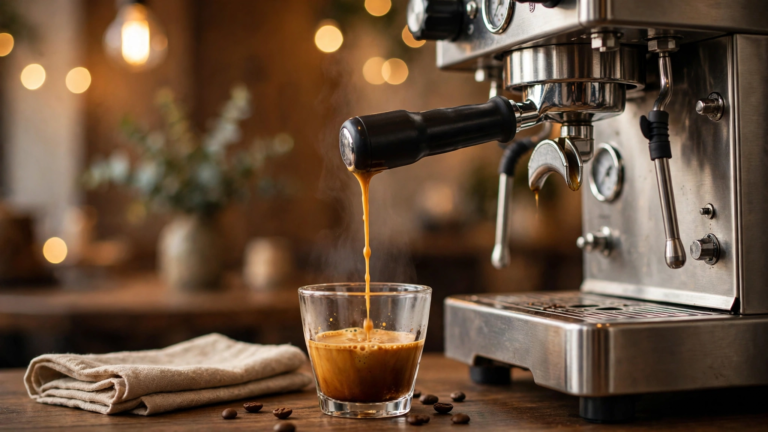
| Espresso | 1:2 | Measured as dry dose in vs. liquid out — e.g. 18 g in, 36 g out — see our espresso guide |
| AeroPress | 1:12 – 1:16 | Flexible by recipe; start at 1:14 |
Espresso deserves a special note: it is the one method that does not follow the golden-ratio logic at all. Espresso ratio compares the dry coffee dose going in to the liquid espresso coming out — 18 grams in and 36 grams out is a 1:2 ratio, usually pulled in about 25–30 seconds. Do not try to apply 1:16 to an espresso machine.
How to make it stronger or weaker (without guessing)
Do not jump to a new ratio blindly. Move one step inside the range and taste before changing anything else:
- Too weak or watery? Move toward 1:15 (more coffee).
- Too strong or bitter? Move toward 1:17 (less coffee).
- Change one variable at a time. If you change the ratio and the grind size together, you will never know which one fixed the cup.
Strength preference is personal — the chart gives you the balanced middle, and your palate sets the final number. Write down what you change; the best home brewers keep a tiny log until the recipe is dialed in.
Scale vs. spoons: why weighing wins
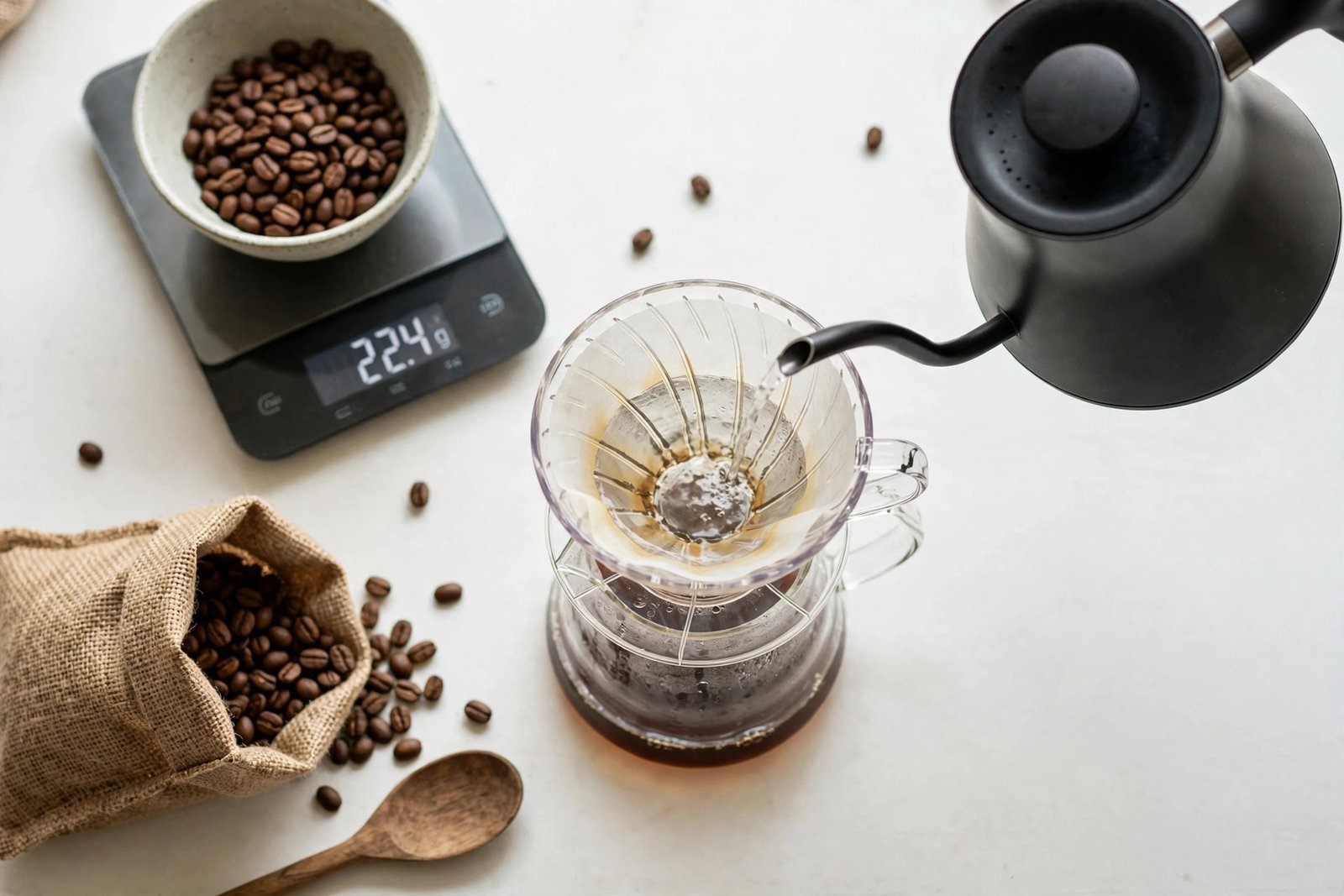
A kitchen scale is the single biggest upgrade a home brewer can make, and it costs less than a bag of good beans. Here is why: a “tablespoon” of coffee is not a fixed weight. Depending on grind size and bean density, one level tablespoon of medium-ground coffee holds roughly 5 to 7 grams. That is a 40% swing hiding inside the same spoon.
If you brew with spoons anyway, follow two rules: always use level tablespoons (never heaping), and stay consistent so your adjustments mean something. A standard coffee scoop equals 2 level tablespoons — about 10 grams — which is why the chart above includes a scoop column. But when a recipe matters, weigh it: 15 grams is 15 grams, every single time. A decent burr grinder paired with a scale is what turns “good enough” coffee into repeatable coffee.
5 ratio mistakes that ruin good coffee
1. Measuring the coffee in the cup, not the water going in. Ratios count brewing water poured into the brewer. Grounds retain water, so the cup always holds less than you poured.
2. Treating carafe “cups” as 8-ounce mugs. A 12-cup pot at 5-ounce markings needs about 111 grams of coffee at 1:16 — not the 178 grams the mug chart shows for 12 eight-ounce cups. Use the carafe table above.
3. Heaping vs. level spoons. A heaping tablespoon can hold nearly twice a level one. If your coffee swings wildly day to day, this is usually why.
4. Changing grind and ratio at the same time. Grind size changes extraction just as much as ratio does. Dial in one, then the other — and start with fresh beans, since stale coffee tastes flat at any ratio.
5. Forgetting that ice is water. Iced coffee dilutes as the ice melts. Brew it a touch stronger (toward 1:15) or brew directly over ice to compensate.
Frequently asked questions
How much coffee should I use per cup?
For a 6-ounce coffee-maker cup, use about 10 grams — 2 level tablespoons. For an 8-ounce mug, use about 15 grams — 3 level tablespoons. Both follow the 1:16 golden-ratio area the National Coffee Association and Specialty Coffee Association guidance points to.
What is the golden ratio for coffee?
The National Coffee Association defines it as 1–2 tablespoons of ground coffee per 6 ounces of water; the Specialty Coffee Association’s Golden Cup Standard is 55 grams per liter (about 1:18). In practice, most specialty brewers work between 1:15 and 1:18, with 1:16 the most common starting point. (Breville’s coffee-to-water ratio guide walks through the same NCA figures with worked examples.)
How many tablespoons of coffee do I need for 12 cups?
It depends on your cup size. At 1:16, a 12-cup pot with 5-ounce carafe cups needs about 22 tablespoons (111 g); with 6-ounce cups, about 27 tablespoons (133 g). For twelve 8-ounce mugs, 36 tablespoons (178 g).
Is a 1:16 ratio strong or weak?
It is the balanced middle. If 1:16 tastes weak to you, move to 1:15; if it tastes too intense, move to 1:17. The lower the second number, the stronger the cup.
Should I weigh my coffee or just use spoons?
Weigh it if you can — a tablespoon of grounds varies between about 5 and 7 grams depending on grind and bean, so spoons are approximate by nature. Spoons are fine for everyday brewing as long as they are level and consistent.
Does the ratio change for espresso?
Yes, completely. Espresso uses about a 1:2 ratio of dry coffee to liquid espresso out (for example, 18 g in, 36 g out). The 1:16 golden ratio does not apply to espresso.
Why does my coffee taste weak even with the right ratio?
The usual suspects, in order: grind too coarse for the method, stale beans, water below brewing temperature (aim for 195–205°F / 90–96°C), or carafe-cup confusion putting in less coffee than you think.
How many scoops of coffee do I need for 12 cups?
About 18 scoops for twelve 8-ounce mugs (178 g at 1:16), 11 scoops for a 12-cup pot with 5-ounce carafe cups (111 g), or 13–14 scoops with 6-ounce carafe cups (133 g). A standard coffee scoop holds 2 tablespoons, about 10 grams — but scoops vary by brand, so check yours or weigh once and note the result.
What is the coffee to water ratio for a Chemex?
1:16 works beautifully — the same golden ratio as other pour-overs. Use a medium-coarse grind (coarser than a V60, since the Chemex’s thick filter slows the drawdown) and the same per-cup math as the chart above. For a 6-cup Chemex (30 oz), that is about 56 g, or 11 tablespoons.
Should cold brew be a concentrate or ready to drink?
Both exist, and the ratio tells you which you made. A concentrate uses 1:4 to 1:8 and gets diluted 1:1 with water or milk before drinking; ready-to-drink cold brew uses 1:12 to 1:15 straight over ice. If your cold brew tastes overwhelmingly strong, you probably made a concentrate — dilute it instead of dumping it.
1:16 vs 1:17 vs 1:18 — which golden ratio should I use?
Start at 1:16. The SCA’s Golden Cup Standard (55 g/L) works out to about 1:18, the NCA’s guidance centers near 1:16, and most specialty recipes fall between 1:15 and 1:17. The differences are small — one step in either direction — so treat 1:16 as home base and move toward 1:15 for stronger or 1:17–1:18 for lighter, tasting as you go.
Why does one scoop per cup taste weak?
Because coffee-maker “cups” are only 5–6 ounces while your mug is 8–12, and one scoop (~10 g) in 8 ounces of water is about 1:24 — far weaker than the 1:16 golden ratio. The fix is not more scoops per cup; it is measuring by the chart above: about 3 tablespoons (1½ scoops) per 8-ounce mug.
The bottom line
Memorize one number — 1:16 — and one conversion — a level tablespoon is about 5 grams, a scoop about 10. With those two, the coffee to water ratio chart above, and the per-method ranges, you can walk up to any brewer, any pot size, and any bag of beans and get the dose right on the first try. Start at 1:16, move toward 1:15 for stronger or 1:17 for lighter, change one thing at a time, and let your taste have the final vote.