How to Make Coffee Without a Coffee Maker (8 Ways)

No coffee maker? No problem. To learn how to make coffee without a coffee maker, you only need three things: ground coffee, hot water, and a way to separate the grounds from the drink afterwards.
A coffee maker does exactly two jobs — it gets hot water onto the grounds, and it separates the grounds from the cup. Anything that does those two jobs can make good coffee, and this guide covers eight ways to do it with things you already own: a saucepan, a mug, a jar, a paper filter, or just a pot over a fire.
If you are learning how to make coffee without a coffee maker, the easiest way is the saucepan method: heat water, take it off the heat, stir in ground coffee, wait four minutes, let the grounds settle, and pour carefully — or through a strainer. That is all a French press does, without the press. If you have a coffee filter, a clean cloth, a jar, or even just a mug, there are several other ways to get a good cup.
The Four Rules That Apply to Every Method
Get these right and any of the methods below makes good coffee.
1. Amount: about 15 g of ground coffee, roughly 3 level tablespoons, for an 8 oz (240 ml) mug. That is the 1:16 ratio — 1 g of coffee for every 16 g of water. The full chart is in our coffee to water ratio chart.
2. Water: just off the boil, about 30 seconds after it stops bubbling. That is roughly 195–205°F (90–96°C). Do not boil the coffee itself — simmering grounds over the heat extracts far too much, and the result is harsh and bitter. Take the pan off the heat before the coffee goes in.
3. Time: about 4 minutes of steeping for medium-coarse grounds. Shorter and the cup is weak and sour; much longer and it turns bitter and dry.
4. Separate: let the grounds settle, then pour slowly — or pour through a strainer, a paper filter, or a clean cloth. The separation is the whole trick. A fine tea strainer catches most of it; a paper filter or a clean cotton cloth catches almost everything.
Which Method Should You Use?
Not sure how to make coffee without a coffee maker? Start with the saucepan method for the most forgiving cup, or the mug steep if you only need one.
| Method | You need | Grind | Time | In the cup |
|---|---|---|---|---|
| 1. Saucepan | Saucepan, strainer (optional) | Medium-coarse | About 8 min | Full-bodied; clean if strained |
| 2. Mug steep | Mug, kettle, second mug | Coarse | About 6 min | Full-bodied, simple |
| 3. Coffee bag | Paper filter, string | Medium | About 5 min | Clean |
| 4. Jar “French press” | Jar, strainer | Coarse | About 6 min | Full-bodied |
| 5. Makeshift pour over | Paper filter, sieve or funnel | Medium-fine | About 5 min | Clean |
| 6. Cowboy coffee | Pot, campfire or stove | Coarse | About 8 min | Bold, some sediment |
| 7. Turkish-style | Small pot | Powder-fine | About 5 min | Strong, thick, unfiltered |
| 8. Cold brew | Jar, strainer, fridge | Coarse | 12–24 hours | Smooth, for iced coffee |
1. The Saucepan Method (Best All-Rounder)
The most reliable method, because it is a French press without the press. If you are learning how to make coffee without a coffee maker, start here. Steeping in hot water, rather than boiling, keeps it from turning bitter.
- Heat the water in a saucepan until it just boils, then take it off the heat and wait about 30 seconds.
- Stir in coarse ground coffee, about 15 g per 8-ounce mug. Make sure every bit is wet.
- Cover and wait 4 minutes. A lid or a plate keeps the heat in.
- Settle the grounds. Stir once, then sprinkle a spoonful of cold water over the surface — the cold water helps the floating grounds sink. Wait another minute.
- Pour slowly into your mug, leaving the last bit and the grounds in the pan. For a cleaner cup, pour through a fine sieve.
Do not boil the coffee itself. Simmering grounds over the heat extracts far too much, and the result is harsh and bitter. Take the pan off the heat before the coffee goes in. A sieve plus a paper coffee filter, or a clean cotton cloth, catches almost everything; a fine tea strainer gets most of it.
2. Steeping in a Mug (Best for a Hotel Room)
The quickest method for one cup when you are learning how to make coffee without a coffee maker, and the one for a hotel room with a kettle.
- Add 15 g of coarse ground coffee to a mug. Pour in 240 g of water just off the boil.
- Stir, cover with a saucer, and wait 4 minutes.
- Stir once, then wait another minute for the grounds to sink.
- Pour into a second mug, through a strainer if you have one, leaving the sludge behind.
No second mug? Drink it carefully from the first one and stop before the last mouthful — the grounds settle at the bottom, and the last sip is where they live.
3. A Homemade Coffee Bag (Cleanest Cup Without Gear)
The tea-bag method, and the cleanest cup on this list without any equipment — a neat trick to know when you are learning how to make coffee without a coffee maker.
- Put 15 g of ground coffee in the middle of a paper coffee filter.
- Gather the edges and tie them tightly with string or unwaxed dental floss, leaving a tail to lift it out.
- Drop it in a mug, pour 240 g of hot water over it, and steep for 4 to 5 minutes, dunking it a few times.
- Lift the bag out by the tail and throw it away.
Use a medium grind for this one — too fine and the bag clogs and the cup is weak; too coarse and the flavor is thin. It is the best method in this guide if you hate sediment, because the grounds never touch the cup at all.
4. The Jar “French Press” (Best If You Own a Jar)
A French press made from a jar and a strainer — another way to learn how to make coffee without a coffee maker with things you already own.
- Add coarse ground coffee to a jar — 15 g per 8 oz mug — and pour in water just off the boil.
- Stir, cover loosely, and steep for 4 minutes.
- Pour slowly through a fine strainer into your mug, leaving the grounds in the jar.
If you own an actual French press, this is the same method with better equipment — see our French press guide for the full version. The jar version works because the steeping is the same; only the separation is cruder.
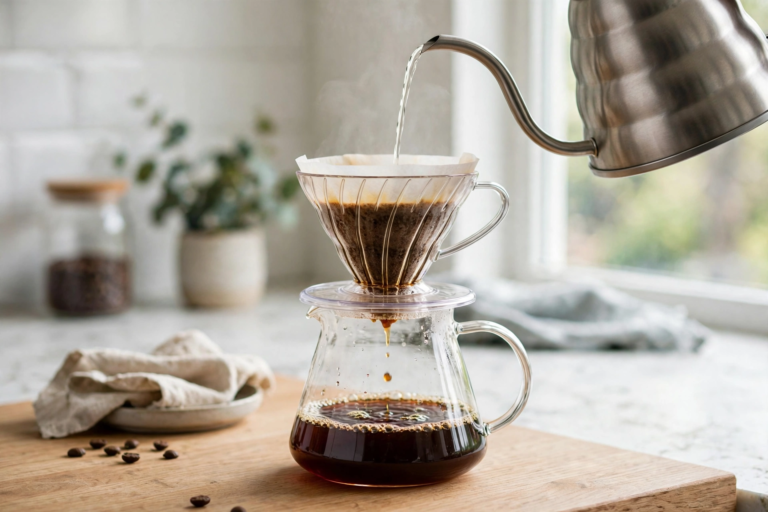
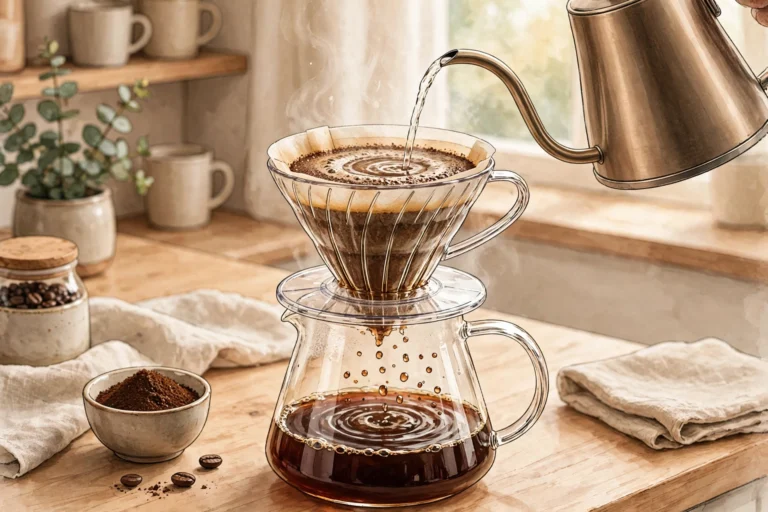
5. A Makeshift Pour Over (Best Tasting Cup)
If you have paper filters and a funnel or sieve, you have most of a pour over — and one of the best-tasting ways to learn how to make coffee without a coffee maker.
- Set a paper filter in a sieve or funnel over a jug or mug.
- Add 20 g of coffee ground medium-fine.
- Pour 320 g of hot water over it in a few slow stages, starting with a small bloom pour and waiting 30–45 seconds, then pouring the rest in slow circles.
- Let it drain fully, then remove the filter and drink.
This is the best-tasting cup in this guide, because the paper filter gives you the clean pour over flavor — and it is the closest thing to a real pour over setup. For the full method with a proper dripper, see our pour-over guide for beginners.
6. Cowboy Coffee (Best for a Campsite)
The campfire version of saucepan coffee, made in one pot with no filter. It is strong and a little rustic.
- Bring the water to a boil in a pot over the fire or stove, about 8 oz per person plus a little extra.
- Move the pot off the heat for 30 seconds, then stir in coarse ground coffee, about 2 heaping tablespoons per 8 oz.
- Cover and wait 4 minutes for the grounds to settle.
- Pour slowly into your mug, stopping before the grounds at the bottom.
Expect some sediment — that is part of cowboy coffee, not a mistake. The cold-water sprinkle from the saucepan method helps here too: a spoonful of cold water over the surface settles the floating grounds before you pour.
7. Turkish-Style Coffee (Strongest Cup)
A small pot, very finely ground coffee, and low heat. Strong, thick, and unfiltered by design.
- Fill a small pot with about 6 oz of cold water per cup.
- Add about 2 teaspoons of powder-fine coffee per cup, and sugar if you take it.
- Heat on low, stirring once at the start, until the coffee just begins to foam — do not let it boil.
- Pour into a small cup, grounds and all, and wait a minute for the grounds to settle before drinking.
Turkish coffee is meant to be drunk with the grounds in the cup, so do not strain it and do not drink the last mouthful. The grind must be powder-fine — finer than espresso — or the cup is gritty instead of thick.
8. Cold Brew in a Jar (Best for Iced Coffee)
No heat, no equipment, just time. Coarse coffee steeps in cold water overnight, and the result is smooth and naturally sweet.
- Add coarse ground coffee to a jar — about 100 g to 800 ml of cold water (a 1:8 ratio) for a concentrate, or 1:12 to 1:15 for ready-to-drink.
- Stir, seal, and leave it in the fridge for 12–24 hours.
- Strain through a fine sieve, then through a paper filter or clean cloth for a cleaner cup.
- Drink the concentrate diluted 1:1 with water or milk, or drink the ready-to-drink version straight over ice.
One batch keeps for about a week in the fridge. The full method, with ratios and dilution math, is in our cold brew guide.
What About Instant Coffee?
Instant coffee is the ninth option, and the honest one: if you are learning how to make coffee without a coffee maker and have no time at all, it needs no method at all. Stir a spoonful into hot water and it is done in two minutes. The flavor is simpler and flatter than any method above, but on a morning with no time and no gear, it beats no coffee. If you drink it often, buy a decent instant — the gap between bad and good instant is bigger than most people think.
5 Mistakes That Ruin Coffee Without a Coffee Maker
1. Boiling the grounds. The single biggest mistake. Water goes in just off the boil, and the grounds never see a rolling boil — boiling extracts harsh, bitter compounds that no amount of sugar fixes.
2. Using the wrong grind for the method. Coarse for steeping (saucepan, mug, jar, cowboy, cold brew), medium for the coffee bag, medium-fine for the makeshift pour over, powder-fine for Turkish. A fine grind in a steeping method over-extracts and turns to sludge; a coarse grind in a pour over runs straight through and tastes weak.
3. Pouring too fast at the end. The last pour is where the grounds come through. Pour slowly, stop before the sediment, and leave the last mouthful in the pan or pot.
4. Guessing the amount. “A few spoonfuls” is how weak coffee happens. The rule is 15 g — about 3 level tablespoons — per 8 oz mug, and the full chart is in our coffee to water ratio chart.
5. Using stale coffee. No method saves stale beans. Buy fresh, grind close to brewing, and store the bag properly — see our guide to choosing fresh coffee beans.
Frequently Asked Questions
Can you make good coffee without a coffee maker?
Yes. Learning how to make coffee without a coffee maker is simple, because a coffee maker only heats water and separates grounds — a saucepan, a mug, or a jar does both jobs. The saucepan method makes a cup as good as a French press, and the makeshift pour over makes a cup as clean as a real dripper. The method matters less than the four rules: 15 g per 8 oz mug, water just off the boil, about 4 minutes of steeping, and a slow pour that leaves the grounds behind.
What is the easiest way to make coffee without a machine?
The easiest way to learn how to make coffee without a coffee maker is the saucepan method: heat water, take it off the heat, stir in coarse coffee, wait 4 minutes, let the grounds settle, and pour slowly. It needs nothing but a pan and a mug, and it is the most forgiving method on this list.
How do you make coffee in a hotel room?
Steep it in a mug: 15 g of coarse coffee, 240 g of water just off the boil, cover with a saucer, wait 4 minutes, stir once, wait another minute, and pour into a second mug. A hotel kettle and two mugs are all you need.
Can I make coffee without a filter?
Yes — five of the eight methods on this list use no filter at all. The grounds settle to the bottom and you pour carefully, leaving the last bit behind. A fine sieve helps, but it is not required. Only the coffee bag and makeshift pour over methods need a paper filter.
How much coffee do I need without a coffee maker?
The same as with one: about 15 g (3 level tablespoons) per 8 oz mug, at a 1:16 ratio. For two mugs, 30 g and 480 ml of water. The full chart is in our coffee to water ratio chart.
Is cowboy coffee safe to drink?
Yes, as long as the water is boiled first and the grounds are left to settle. The grounds themselves are not harmful — they are just unpleasant to swallow. Pour slowly, stop before the sediment, and do not drink the last mouthful.
The Bottom Line on How to Make Coffee Without a Coffee Maker
You do not need a machine to learn how to make coffee without a coffee maker. You need ground coffee, water just off the boil, about four minutes, and a way to keep the grounds out of the cup.
The saucepan method is the best all-rounder, the mug steep is the fastest for one cup, the coffee bag is the cleanest without gear, and cold brew is the one to make the night before. Learn the four rules — 15 g per 8 oz mug, water just off the boil, four minutes, pour slowly — and any kitchen, hotel room, or campsite becomes a coffee shop. For the methods with real equipment behind them, our French press guide, pour-over guide, and cold brew guide take it from here.
Sources: Coffee Brew Guide — Coffee Without a Coffee Maker; Craft Coffee Guru — 8 Ways to Make Coffee Without a Coffee Maker.